











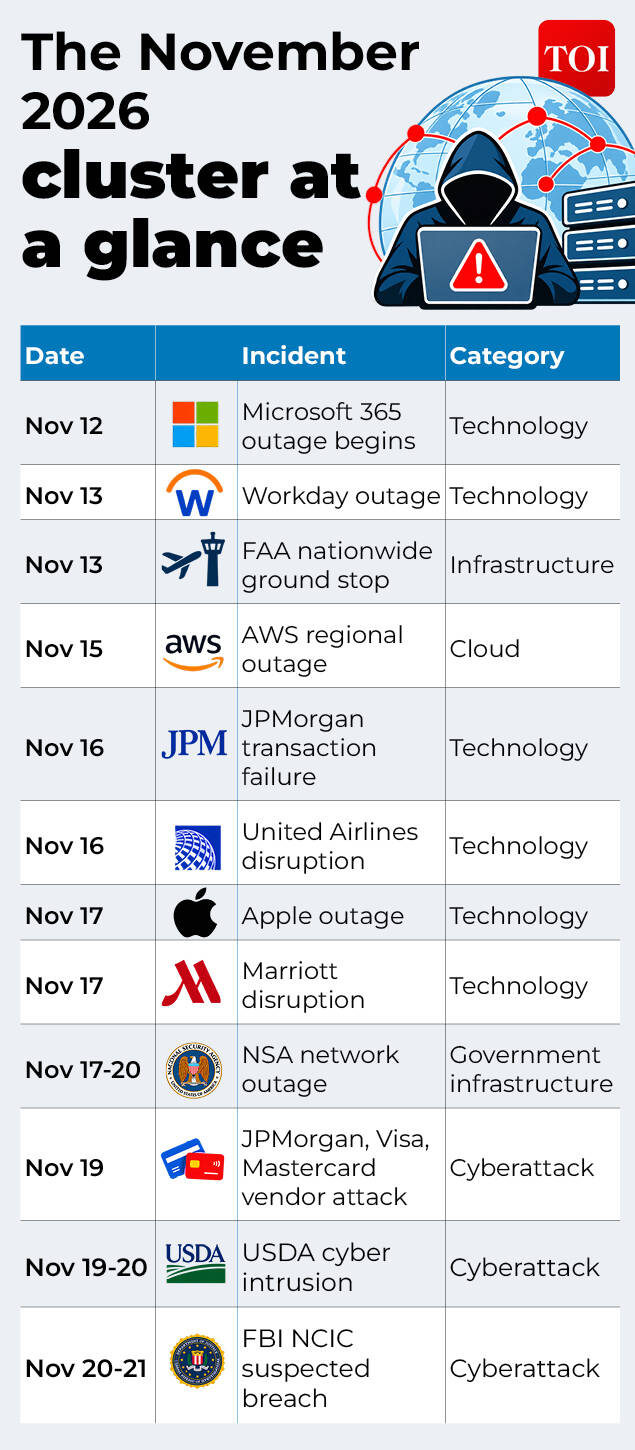
From a suspected breach of the FBI’s crime database to outages affecting Microsoft, Amazon Web Services and the Federal Aviation Administration, a series of back-to-back incidents has put America’s digital infrastructure under scrutiny. While the disruptions have different causes, they raise questions about software vulnerabilities, third-party risks and the resilience of systems powering government agencies and private companies.The Federal Bureau of Investigation (FBI) is investigating a suspected breach of its National Crime Information Center (NCIC), a sensitive database used by law enforcement agencies across the United States. The suspected breach has raised fresh concerns about government cybersecurity, coming amid reports of a separate intrusion involving a US Department of Agriculture (USDA) system used for farmer payments.The NCIC contains information on fugitives, missing persons, criminal histories and stolen property. The extent of the suspected breach, the information potentially accessed and the identity of those responsible remain unclear.President Donald Trump, responding to the report, said: “We just heard about it and I will say that it’s not good.”The FBI incident comes amid a series of technology disruptions affecting major US organisations. Microsoft 365, the Federal Aviation Administration (FAA), Amazon Web Services (AWS) and the National Security Agency (NSA) have all faced outages or network problems in November. JPMorgan Chase, Visa and Mastercard have also disclosed a cyber incident involving a third-party service provider.
–
These incidents do not point to one coordinated cyberattack. Some involved suspected unauthorised access, while others resulted from software defects, network failures or maintenance-related problems. But together, they expose a common challenge: America’s growing dependence on interconnected digital systems, where a failure in one component can affect services far beyond the organisation directly involved.
FBI and USDA incidents raise concerns over government data
The suspected NCIC breach has added to scrutiny of the FBI’s cybersecurity arrangements. In September, the hacking group ShinyHunters claimed to have compromised the bureau’s recruitment website. In March, the FBI disclosed suspicious activity involving an internal system containing sensitive surveillance and law-enforcement information.The USDA has also been dealing with a reported cybersecurity incident. The department’s security operations centre reportedly identified an intrusion that led IT staff to take multiple applications offline and reset database passwords.The disruption affected financial tools used to facilitate payments to farmers, including programmes linked to crop insurance and agricultural losses. The identity of the attackers and whether information was stolen had not been established in the reporting discussed.These cases highlight the risks associated with government databases containing sensitive personal, financial and law-enforcement information. However, the distinction between an attempted intrusion, a confirmed breach and actual data theft remains important. The full scope of the FBI and USDA incidents is still unclear.
November’s outage cluster: Microsoft, FAA, AWS and NSA
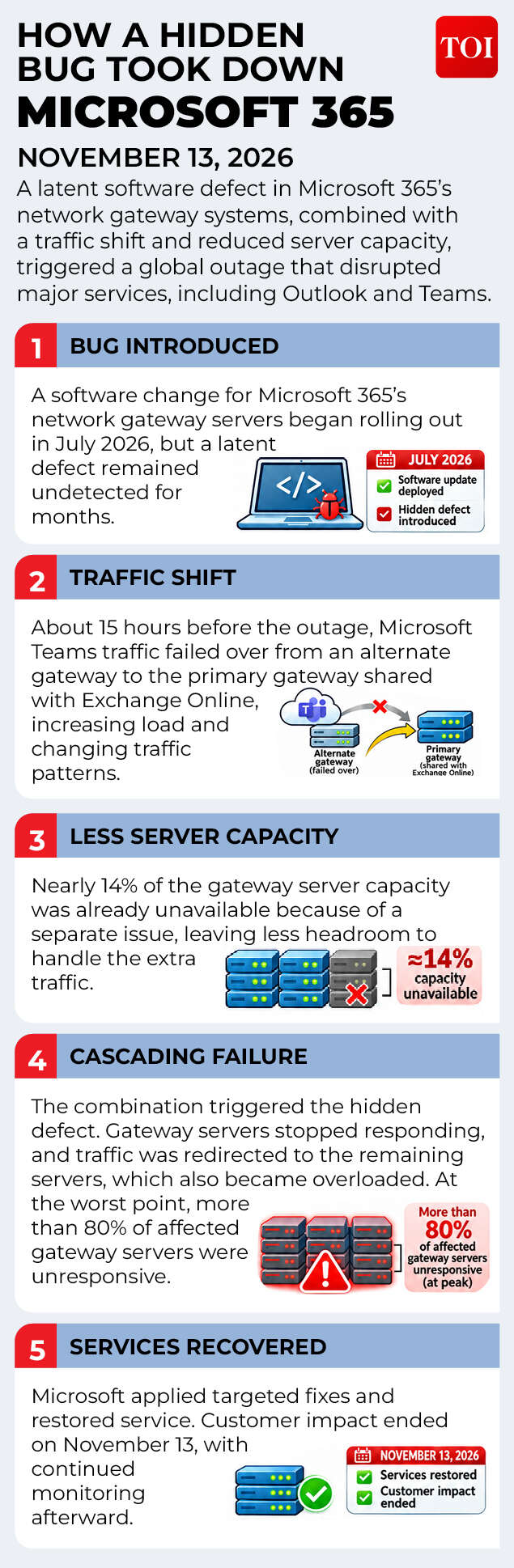
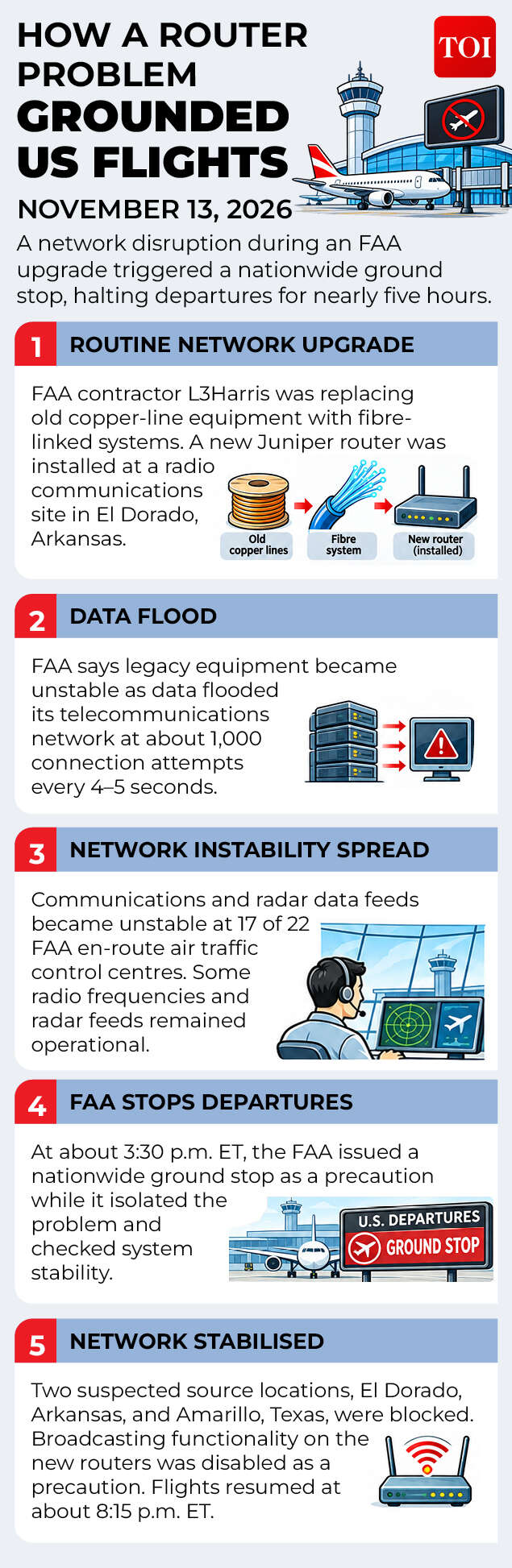
The Microsoft 365 outage, which began on November 12, affected services including Outlook, Teams and Exchange Online. Microsoft’s post-incident explanation pointed to a combination of a latent software defect, increased network traffic and reduced server capacity.A software change introduced in July had created a defect in the company’s gateway infrastructure. The issue remained undetected until Teams traffic was shifted from an alternate gateway to a primary gateway also handling Exchange Online.The primary system was already operating with nearly 14% less capacity than normal. As servers became unresponsive, traffic was redirected to the remaining infrastructure, increasing pressure on it. At the peak, more than 80% of the affected gateway servers were reportedly unresponsive.Microsoft applied fixes and restored services by November 13. The company said there was no evidence of malicious activity.The incident showed how a dormant software defect can trigger a wider failure when combined with increased traffic and insufficient backup capacity.The FAA faced a different problem on November 13. A network disruption linked to a router installation at a communications facility in El Dorado, Arkansas, forced the agency to issue a nationwide ground stop.
–
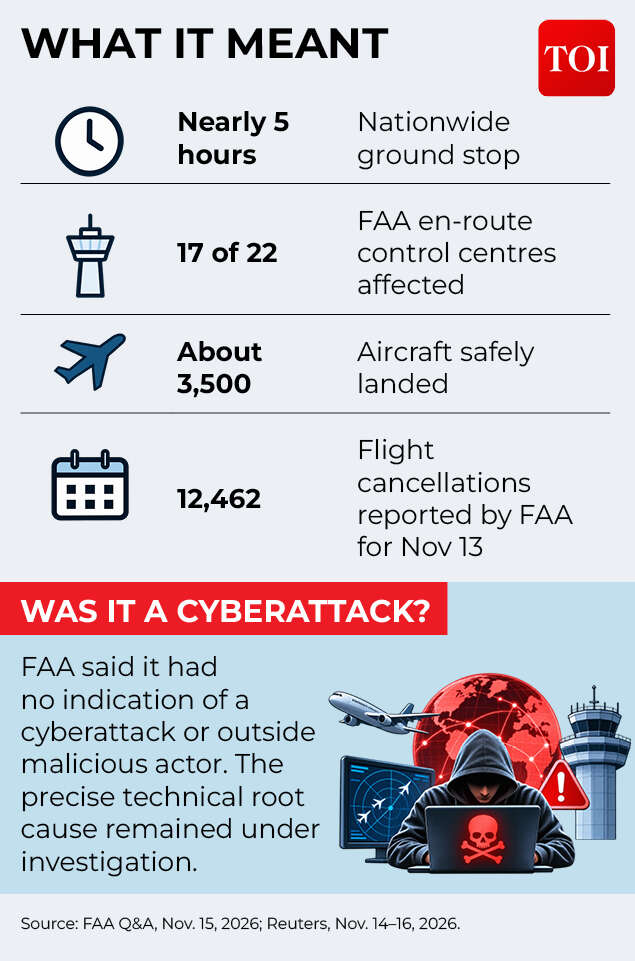
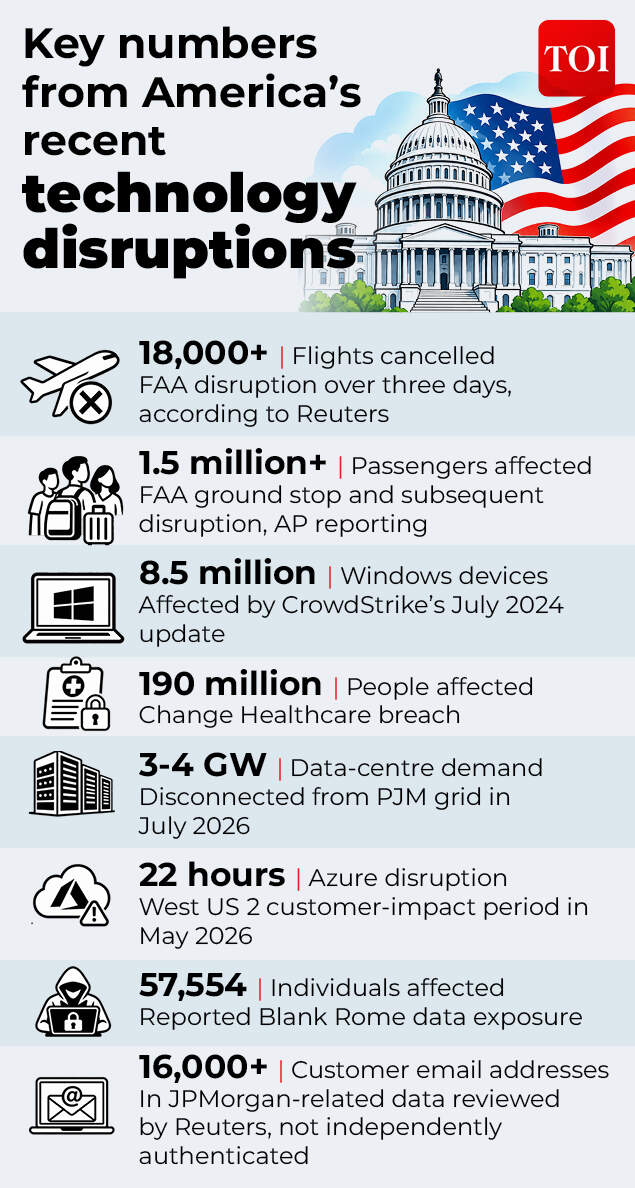
The installation was part of an upgrade to replace older copper-line equipment with fibre-linked systems. Officials said the network experienced an abnormal volume of connection attempts, reportedly around 1,000 every four to five seconds. The disruption affected communications and radar data feeds at 17 of the FAA’s 22 en-route air traffic control centres.The agency halted departures as a precaution. The ground stop lasted nearly five hours, while Reuters reported more than 18,000 flight cancellations over the following days. The FAA suspended further deployment of the routers while it investigated the incident. Officials said they had no indication of a cyberattack, and the precise technical cause remained under investigation.
–
On November 15, AWS reported connectivity and authentication problems in its US-East-1 region in Northern Virginia. The disruption affected several cloud services, with most restored within hours.Other companies also reported problems. JPMorgan Chase experienced a transaction-processing failure on November 16 attributed to a software bug. United Airlines reported flight delays linked to a system problem, while Apple services and Marriott’s website and app also faced disruptions.The NSA’s internal classified network, NSANet, experienced a disruption during maintenance and software patching. Officials indicated that patches applied after a PHP vulnerability alert caused some systems not to restart as expected. The disruption lasted several days, but officials said mission-critical intelligence operations continued.The incidents had different technical causes. They nevertheless demonstrate how software defects, network equipment, maintenance and capacity constraints can disrupt essential services even without a malicious attack.
–
When a trusted digital certificate is not secure
Beyond network failures, cybersecurity researchers are warning about weaknesses in the systems organisations use to establish digital trust.Digital certificates verify the identity of websites, software publishers and online services. They rely on cryptographic keys, including private keys. If a private key is generated using a flawed process, a certificate may appear legitimate even though its underlying security is compromised.The issue has come into focus following concerns around private key generation involving eMudhra, a certificate authority.
–
Saurabh Sharma, Lead Security Researcher at Kaspersky’s Global Research and Analysis Team (GReAT), said conventional security tools may fail to identify weaknesses in the way cryptographic keys are generated.“A certificate can pass every standard check and still not be safe to trust. In our DAEMON Tools investigation, trojanized installers carried a valid digital signature from the developer and came from the official website, so signature checks alone raised no alarm. Most security tools watch traffic and code, so a weakness in how a key was generated stays just as invisible.”Sharma said organisations should monitor certificate transparency logs, independently test public keys for weak patterns and examine how certificate authorities audit key generation. Shorter certificate lifespans can also reduce the period during which a flawed key can be misused.Another problem arises when certificates are revoked or no longer trusted by browsers, but backend systems continue using outdated trust lists.“Browsers get fixed quickly, while backend systems are often forgotten,” Sharma said.He cited Kaspersky’s research into container security, which found critical vulnerabilities in 64 of 100 popular Docker Hub images sampled. Only one in ten was fully up to date.“Pre-built images do not patch themselves. They must be rebuilt and redeployed by hand, and the same applies to any trust list baked into them. Organisations should list every trust store in use across operating systems, runtimes, base images and bundled libraries, rebuild images on a fixed schedule and treat trust store updates like critical patches.”The concern is that organisations may update their main applications while overlooking outdated software components, libraries and certificate stores embedded in their systems.
PHP2Shell and the shrinking window to patch vulnerabilities
The speed at which vulnerabilities are discovered and exploited is creating another challenge for security teams.The PHP2Shell vulnerability has raised questions about protecting web servers against flaws that can be triggered before application-level security controls come into play.A web application firewall (WAF) can block known malicious request patterns, but it cannot replace a security patch. It must also distinguish malicious traffic from legitimate requests, particularly when websites handle large file uploads.Sharma said organisations need a layered approach.“A flaw that triggers before application code runs leaves a firewall little to work with, but not nothing. Our Q4 2025 report on exploits and vulnerabilities shows that several flaws were exploited in the wild almost immediately after publication, so speed matters.”He recommended virtual patching rules, strict limits on request structures and rate limiting. Upload endpoints should have separate size thresholds to avoid blocking legitimate large files.However, these measures only buy time. “A firewall buys time, and patching remains the fix,” Sharma said.The challenge becomes more serious when vulnerability information or software patches become public. Attackers can analyse code changes to understand what has been fixed and develop exploits before all organisations have updated their systems.“The clock starts for attackers the moment a fix becomes public. As our Q2 2026 report on exploits and vulnerabilities notes, early publication of exploits gives attackers an advantage, leaving developers with little or no time to fix the issue.”Sharma said organisations should reduce the exposure of internet-facing systems, use behavioural detection to identify exploitation attempts and prioritise assets that are most vulnerable.
Software supply chains: When clean source code does not mean safe software
The LiteLLM incident has drawn attention to another weakness: the gap between open-source code available for inspection and the actual software packages that companies download and run.While the official GitHub repository reportedly contained clean code, malicious versions were pushed directly to package repositories, including PyPI and Docker. Users downloading affected packages could therefore be exposed even if they relied on the project’s public source code.Sharma said organisations must verify the software they install rather than assume that clean source code guarantees safety.“Clean source code says nothing about the package that is actually installed. Our OceanLotus research found malicious packages sitting on PyPI since July 2025, and our report on open-source threats recorded a 48% increase in malicious packages by the end of 2024.”He recommended monitoring open-source repositories, checking package names and versions against known threats, pinning software versions and verifying package hashes. Organisations can also use vetted internal repositories to reduce the risk of downloading compromised packages.The problem is particularly relevant to companies building applications using multiple third-party libraries and tools. A malicious dependency can provide attackers with access to systems that are otherwise protected.
AI is accelerating vulnerability discovery
Artificial intelligence is adding another dimension to the cybersecurity challenge. AI tools can analyse large codebases and identify weaknesses that may have remained undetected for years. But attackers can use similar capabilities to automate reconnaissance and search for exploitable flaws.Sharma said both attackers and defenders are increasingly using the same discovery tools.“Defenders and attackers now use the same discovery tools, and the volume shows it. Our Q2 2026 report records an unprecedented number of registered CVEs, driven largely by AI-assisted discovery in third-party software.”He cautioned that older vulnerabilities remain a major threat, even as new flaws are identified.“Veteran vulnerabilities such as CVE-2018-0802 remain among the exploits our solutions detect most often, and ToolShell in SharePoint traced back to an incomplete fix from 2020. Flaws in AI services are rising too, with a tenfold increase between Q4 2025 and Q2 2026.”The persistence of older vulnerabilities suggests that the problem is not just the discovery of new flaws. Organisations often struggle to identify outdated systems, assess which vulnerabilities are actively exploited and deploy fixes across their infrastructure.Sharma said defenders need to prioritise exposed and actively exploited vulnerabilities, while using tools that can detect exploitation behaviour even when a patch is unavailable.
Are compliance certificates enough to establish security?
The growing dependence on third-party providers has also raised questions about the reliability of compliance certifications and security audits.A vendor may meet the requirements of an audit at a particular point in time but remain vulnerable to a newly discovered flaw or a compromised software dependency.Sharma said organisations should not treat compliance certification as proof that a product is secure.“A compliance certificate is a baseline, not proof of security. It shows that a process existed on the audit date, not that the product holds up against a live attacker.”He said enterprise security teams should ask vendors for penetration-test results, software bills of materials, vulnerability disclosure records and evidence of secure software development. Contracts should also include audit rights, alongside continuous monitoring after a vendor has been onboarded.The November cyber incident involving JPMorgan, Visa and Mastercard illustrates the risks. The reported attack involved a third-party service provider, rather than a confirmed compromise of the companies’ core payment networks. It shows how information can be exposed through an external partner even when an organisation’s primary systems remain operational.
A resilience test for America’s digital infrastructure
The November incidents do not establish that America’s digital infrastructure is collapsing or that a single adversary is behind the disruptions. But they expose how dependence on interconnected systems can turn relatively contained problems into wider operational crises.The FAA incident demonstrated the challenges of introducing new equipment into legacy infrastructure. Microsoft’s outage showed how a software defect and capacity constraints can overwhelm systems designed to provide redundancy. The suspected FBI and USDA intrusions, meanwhile, have raised questions about protecting sensitive government information.The risks extend beyond software and cybersecurity. Data centres depend on uninterrupted electricity, cooling and network connectivity. Microsoft’s Azure infrastructure experienced a major power and cooling-related incident in May 2026, underlining how physical infrastructure failures can also disrupt digital services.The response requires more than investing in new technology. Organisations need independently tested backup systems, accurate inventories of software and internet-facing assets, stronger third-party security checks and reliable patch-management procedures.The central lesson is that technological sophistication does not automatically translate into resilience. As AI accelerates vulnerability discovery and software supply chains become more complex, the challenge for the US government and private companies is to ensure that their systems can withstand an intrusion, a software failure or a compromised component without disrupting essential services.