






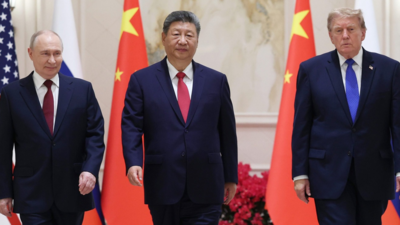
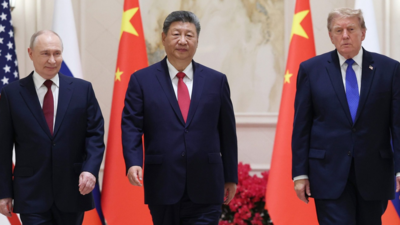
The world looks very different today from what it did when the United Nations was established in 1945. The global order has shifted from bipolar to increasingly multipolar, relations between countries have changed, and several new nations have emerged while others have ceased to exist.Yet, the exclusive club of five permanent members of the United Nations Security Council (UNSC) has remained unchanged, despite longstanding calls for its expansion to give countries like India a greater say in global affairs.Thursday offered a possible glimpse of change in the global governance system as US President Donald Trump, Chinese President Xi Jinping and Russian President Vladimir Putin met in Shenzhen, bringing together the leaders of three of the five permanent members of the UNSC.While the meeting covered several issues, what stood out was their stated commitment to reforming the United Nations.But could this open a window for India’s decades-long ambition of securing a permanent seat at the high table, or will the existing power equations continue to stand in its way?
What was discussed at the trilateral meeting
Three of the world’s most powerful leaders met at a time of deep geopolitical divisions. After around 80 minutes of talks, they emerged with commitments to reform the United Nations, increase the production and supply of refined petroleum products, and hold discussions on reducing nuclear risks.According to the joint statement titled “Declaration toward Peace”, the three leaders held an in-depth exchange of views on the international situation and committed to maintaining strategic stability and international security.
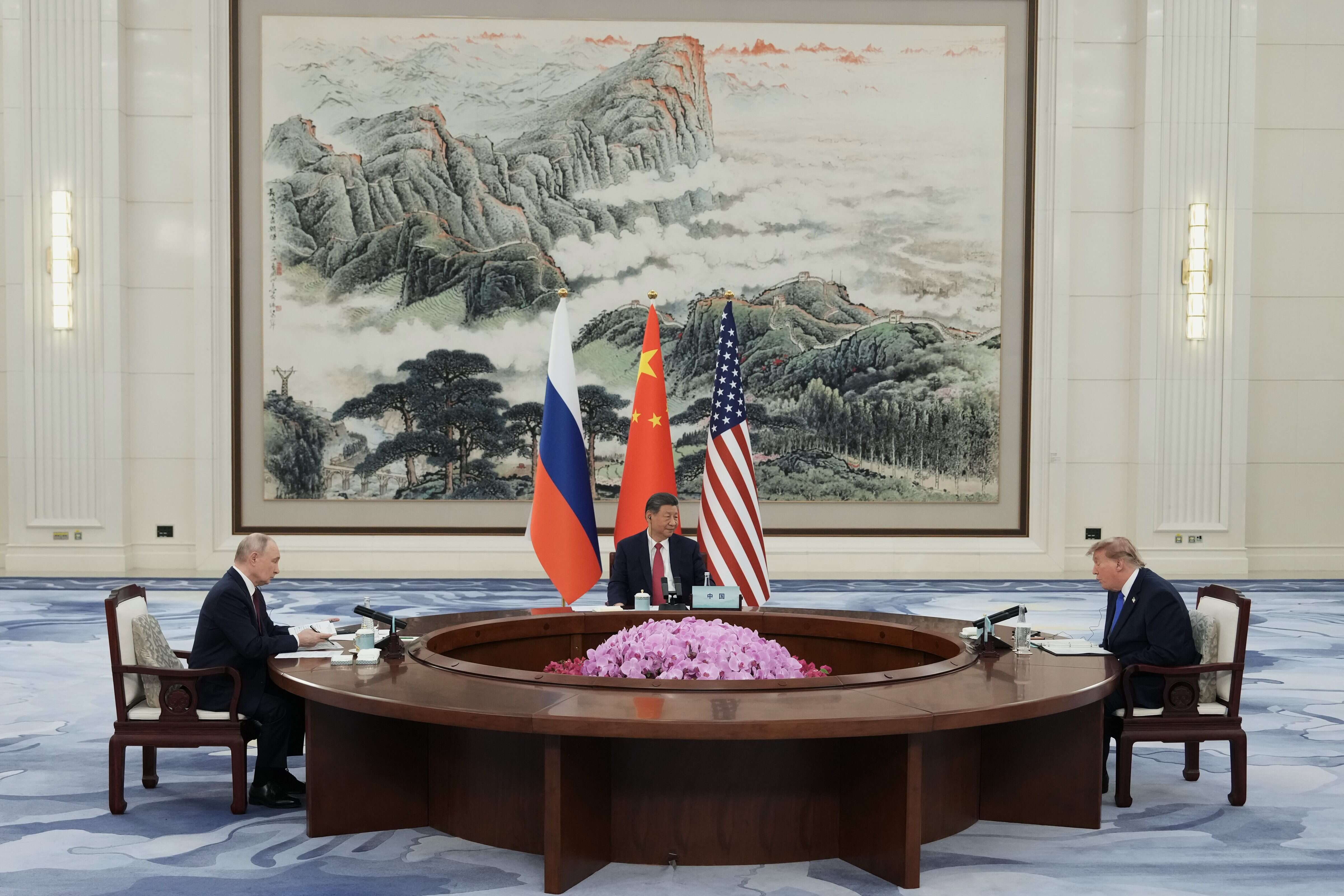
The first point of the declaration addressed reform of the United Nations.“As permanent members of the United Nations Security Council, Russia, China and the United States committed to reform the UN so that the UN can respond more effectively to global challenges and conform to its fundamental mission of international peace and security,” the statement read.The agreement has brought New Delhi’s longstanding demand for a permanent seat on the Security Council back into focus.However, there is an important distinction. The declaration calls for reform of the UN but stops short of spelling out what those reforms would entail or whether they would include an expansion of the Security Council’s permanent membership.That leaves a crucial question unanswered: Are the three powers willing to change the institution’s existing power structure, or do they envision reforms that leave their own privileged positions untouched?
India’s long-standing demand for a seat at the high table
India, a founding member of the United Nations, has sought a permanent seat on the Security Council for decades. New Delhi’s central argument is that a world body created in the aftermath of World War II cannot adequately represent today’s world without giving India, the most populous country, a major economy, a leading democracy and a significant contributor to UN peacekeeping operations, a permanent place at the decision-making table.In 1994, India formally announced its candidature for permanent membership at the 49th UN General Assembly and has consistently reiterated its demand since.However, securing a permanent seat is not simply a matter of obtaining support from a majority of countries.Any expansion of the Security Council’s permanent membership would require an amendment to the UN Charter under Article 108. This needs approval by a two-thirds majority in the 193-member General Assembly and ratification by two-thirds of UN member states, including all five existing permanent members — the US, UK, France, Russia and China.In effect, each of the five permanent members has the power to prevent such an amendment from taking effect, making their consent essential to any expansion.In September this year, external affairs minister S Jaishankar joined his counterparts from Brazil, Germany and Japan, collectively known as the G4, to call for early reform of the Council and expansion in both permanent and non-permanent categories.In a press release, the ministry of external affairs said the G4 ministers emphasised that “it is crucial to implement UNSC reform at the earliest so that the Council is fit-for-purpose, truly reflecting contemporary geopolitical realities.”“They underscored that expansion of the UNSC in both the permanent and non-permanent categories of membership is central to such reform and that this position is supported by a majority of member states. In this context, they reiterated the importance of improving the representation of the underrepresented and unrepresented regions and groups, such as Africa, Asia-Pacific, and Latin America and the Caribbean, in both these categories,” the statement read.India has also voiced similar concerns through the IBSA grouping with Brazil and South Africa. A joint statement supported “transformative” UNSC reform, permanent seats for India and Brazil, and Africa’s aspiration for permanent representation. It also called for a fixed timetable and text-based negotiations during the 81st UN General Assembly.Jaishankar has repeatedly argued that India’s exclusion is not merely a setback for New Delhi but also a problem for the credibility of the United Nations itself.“To have such a country not there in the key global councils, obviously, it’s not good for us, but I would also urge it’s not good for the global Council in question,” Jaishankar said in 2022.
China-Pakistan opposition remains a major hurdle
While India has continued to push for a permanent seat on the Security Council, opposition from China and Pakistan remains among the biggest obstacles to its candidature.Beijing has supported Security Council reform in principle but has stopped short of endorsing India’s individual candidature.China has maintained that reforms should focus on improving the representation of developing countries, particularly African nations, rather than simply adding a small number of new permanent members.During UN discussions, Chinese representatives have argued that the reform process should not be reduced to the individual aspirations of countries seeking permanent membership.In November 2022, China’s then Permanent Representative to the United Nations, Zhang Jun, opposed the adoption of a negotiating text or a timetable for UNSC reform. He warned that such a move could lead to “conflicts” and even “derail the process”.Zhang also criticised countries seeking permanent membership to enhance their international standing, in remarks widely seen as an indirect reference to India and the G4.“Some countries had their own agenda for reforms, seeking permanent membership to enhance their international standing,” he said.Pakistan, meanwhile, is a leading member of the Uniting for Consensus group, also known as the Coffee Club, which opposes the creation of new permanent seats and favours expanding the elected, non-permanent category of membership.Unlike China, Pakistan is not a permanent member and cannot independently block an amendment to the UN Charter through the ratification requirement. However, it can oppose India’s candidature through diplomatic negotiations and coalition-building within the General Assembly.The two countries’ positions, along with differences among the existing permanent members, have complicated efforts to reach an agreement on the future composition of the Security Council.
Is the new agreement a window of opportunity for India?
Speaking to The Times of India, Jawaharlal Nehru University professor Rajan Kumar described the recent summit between the three leaders as more of a diplomatic gesture than a serious commitment to concrete changes in the global governance system.“It is a major development that the three countries have met to discuss UN reform, but I believe it is more of a lip service than a serious commitment towards taking any concrete steps towards oil supply chain, nuclear disarmament, reform in the global governance system,” he said.Kumar argued that despite agreeing on the need for reforms, the three countries have little common ground when it comes to changing the existing power structure of the Security Council.According to him, their competing geopolitical interests make it difficult to expect a consensus on expanding permanent membership, particularly when the existing arrangement gives them considerable influence over international decision-making.“All three countries are opposed to expanding the UNSC. Moreover, the US, Russia and China often use their veto power against each other on issues at the Security Council. When the US raises an issue, China and Russia often align against it, and vice versa. So, do you really expect them to reach a consensus on expanding the UNSC to accommodate countries like Brazil and India?” he asked.
Share your thoughts in the comments
Be respectful · TOI community guidelines
The concern is that while the three countries may agree on the broad need to make the United Nations more effective, they have little incentive to support changes that could dilute their own influence.The Shenzhen declaration has certainly brought the question of UN reform back into the conversation. However, without a specific proposal for Security Council expansion or a commitment from the permanent members to support it, there is little to suggest that the existing power structure is about to change.For India, the agreement may offer a glimmer of hope, but its decades-long ambition of securing a permanent seat remains a distant prospect.The three powers have agreed that the United Nations needs reform. Whether they are willing to share the power that comes with permanent membership is an entirely different question.