








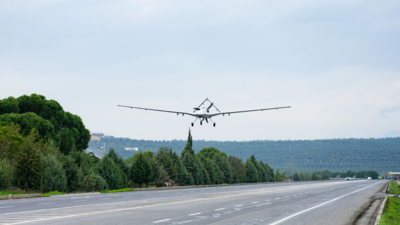
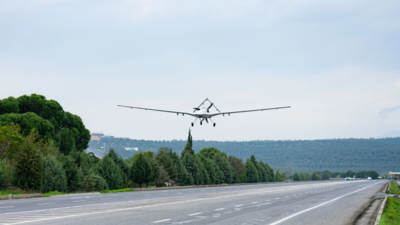
Turkey has in an exercise operated its Akinci and TB2 drones from a highway. This exercise highlights how roads can be used as alternative operating surfaces for military aircraft when conventional runways are unavailable in times of both a conflict or during a calamity. The development is relevant to India as Pakistan operates both these types of drones. Recently during Operation Sindoor, India had smashed many Pakistani air bases, which in times of conflict would force Islamabad to use of road infrastructure to improve the dispersal and survivability of its air assets.Turkey has demonstrated a new dimension of military operations by successfully landing and taking off combat drones from a highway during an emergency exercise. Three unmanned aircraft — an Akinci and two Bayraktar TB2 drones — converged on the Manisa-Balikesir Highway after taking off from separate bases at Kesan, Corlu and Izmir. The exercise, conducted by defence company Baykar in coordination with Turkey’s defence ministry and highways authorities, was designed to demonstrate that unmanned combat aircraft could continue operating when conventional runways were unavailable. Baykar plans to extend the concept to other indigenous platforms, including the Kizilelma unmanned fighter and Bayraktar TB3.Such exercises are becoming increasingly important as air forces prepare for the possibility of conventional airbases being damaged by missiles, drones or precision strikes during a conflict. Dispersing aircraft across alternative operating locations can reduce dependence on a handful of major airfields and provide greater flexibility in sustaining operations. Highway-based operations, however, require more than a suitable stretch of road. They involve coordination with civilian authorities, traffic closures, security arrangements and ground support. Turkey’s exercise also illustrates how unmanned aircraft, which generally have different runway requirements from conventional fighters, can add another dimension to this concept.Pakistan has practised highway operations for several years, the Pakistan Air Force demonstrated the use of the Islamabad-Lahore M-2 Motorway during Exercise High Mark in April 2010, when Mirage III and F-7PG fighters landed, were refuelled and rearmed before taking off. Similar operations were conducted in March 2019 at multiple, publicly unidentified highway locations and again on the M-2 in October 2020. The M-1 Islamabad-Peshawar Motorway also has a documented four-kilometre section designed as an emergency airstrip.In a conflict with India, such facilities could give the PAF alternative locations to recover aircraft and potentially resume sorties if conventional airbases were temporarily unavailable. They could complicate efforts to restrict operations to established airfields and improve dispersal. However, highway landings alone cannot replace a fully equipped airbase, particularly for sustained combat operations requiring maintenance, weapons handling and secure logistics.India has developed a similar capability. Its first Emergency Landing Facility on a national highway was inaugurated on the Satta-Gandhav stretch of NH-925A near Barmer, Rajasthan, in September 2021. The IAF has also practised operations on the Yamuna and Agra-Lucknow expressways. In April 2026, it activated the Purvanchal Expressway facility in Sultanpur for day and night operations involving Sukhoi-30MKI, Mirage-2000, Jaguar, C-295 and AN-32 aircraft. India is thus expanding a network of alternative landing facilities along strategic road corridors.