







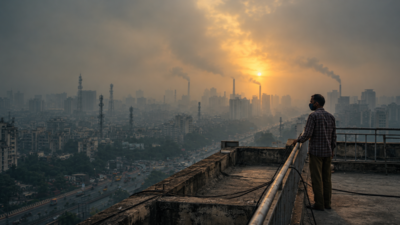
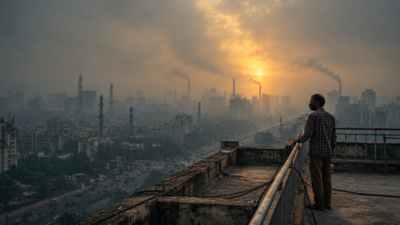
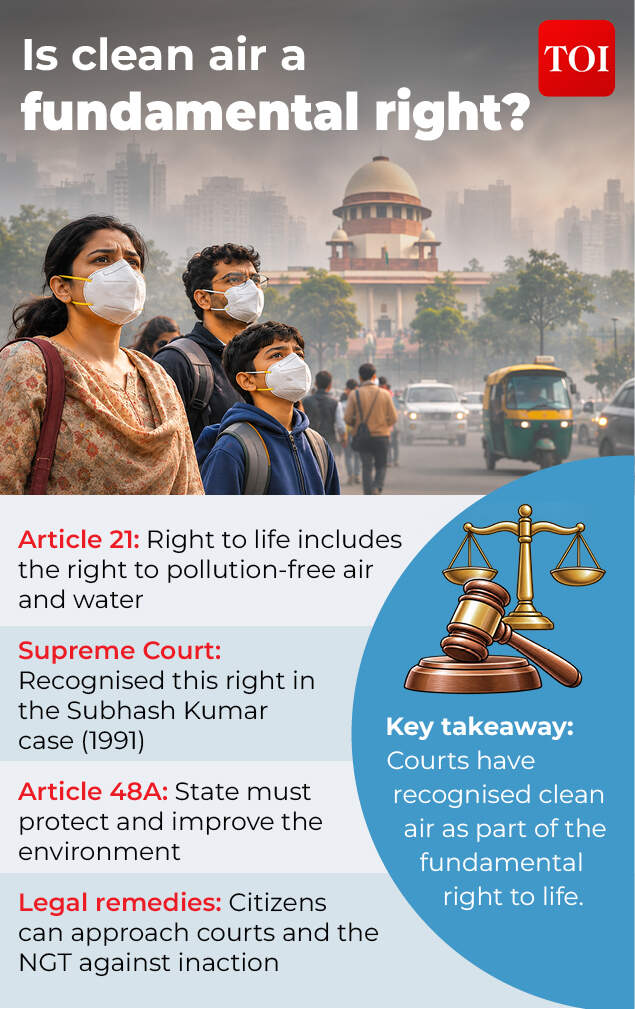
NEW DELHI: Air pollution has become a recurring concern for cities across India, with its effects extending beyond seasonal smog and deteriorating air quality. While governments rely on pollution-control measures and emergency restrictions to tackle the crisis, the larger challenge is ensuring that people are protected from the harmful effects of polluted air.Currently, Delhi’s AQI stands at 491, while Mumbai recorded 132, placing both cities in the poor or worse air quality range. The figures highlight how pollution is affecting cities across the country. With emergency restrictions offering only temporary relief, the question of whether clean air can be treated as a fundamental right becomes very important.Is clean air a legal right in India?Adesh Nandal, Legal Associate at Jotwani Associates, said the Constitution does not specifically mention a fundamental right to clean air. However, courts have interpreted the right to life under Article 21 to include the right to live in a pollution-free environment.In Subhash Kumar v. State of Bihar (1991), the Supreme Court held that the right to life includes the right to enjoy pollution-free water and air. Earlier, in Municipal Council, Ratlam v. Vardhichand (1980), the court held that authorities could not avoid their responsibility to control pollution by saying they did not have enough money.“Right to live is a fundamental right under Article 21 … and it includes the right of enjoyment of pollution free water and air for full enjoyment of life,” Nandal cited the Supreme Court’s observation in the Subhash Kumar case.He said the right is not absolute and courts also consider people’s livelihoods and the country’s economic development while deciding such matters. However, it requires governments to protect citizens from dangerous levels of pollution.What can citizens do if governments fail to act?Nandal said citizens can approach the Supreme Court under Article 32 or high courts under Article 226 through petitions, including public interest litigations (PILs), if authorities fail to do their duty.
–
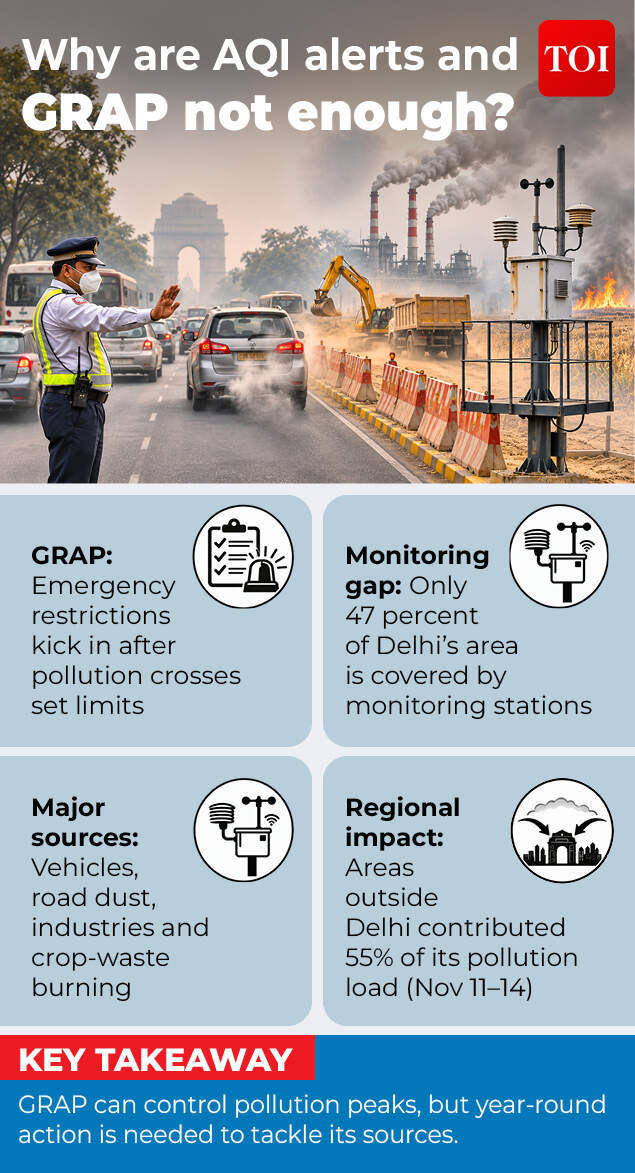
Courts can direct governments to enforce pollution rules, shut down industries that violate them, check whether restrictions are being followed and award compensation in appropriate cases. Citizens can also approach the National Green Tribunal (NGT), which can order polluters to pay compensation and direct steps to repair environmental damage.He said the government’s responsibilities also come from Article 48A, which requires the State to protect and improve the environment, and the Air (Prevention and Control of Pollution) Act, 1981.Under the Air Act, pollution control boards can inspect factories, collect samples to check emissions and take action against units that break pollution rules.“The weakest link is not the law but implementation—which is precisely why courts have retained continuing jurisdiction and why the right remains a live, litigable entitlement,” Nandal said.Why emergency restrictions alone cannot solve the problemPrarthana Borah, Fellow at the Council on Energy, Environment and Water (CEEW), said GRAP is useful in controlling sudden rises in pollution but does not address the sources of pollution throughout the year.“GRAP is reactive in function and not preventive. Actions under GRAP are invoked only after air quality has crossed the threshold, so it treats the symptoms to curb peaks in pollution and is not a long-term strategy to address the underlying sources,” she said.Borah also pointed to gaps in air quality monitoring, saying only 47 percent of Delhi’s area is covered by monitoring stations. This makes it difficult to track pollution levels across the entire city and take action wherever needed.She said air quality forecasts could help authorities act before pollution levels rise sharply. Forecasts could also help them decide when to lift restrictions without doing so too early.Nandal said GRAP cannot replace the government’s responsibility to find out where pollution is coming from and take steps to control it in the long run. Citizens can challenge poor implementation in court, which can ask authorities to submit reports, order inspections and direct them to enforce restrictions.Transport, road dust and pollution from other regionsBorah said air pollution in Indian cities comes from both local and regional sources. These include vehicles, road dust, industries and smoke from burning crop waste.She cited an analysis by the Air Quality Decision Support System (AQDSS) of the Indian Institute of Tropical Meteorology, according to which pollution from districts outside Delhi accounted for 55 percent of the capital’s pollution load between November 11 and 14. Delhi’s own contribution was nearly 36 percent, with vehicles among the major sources.She also cited a Commission for Air Quality Management (CAQM) study which found that dust was the biggest contributor to PM2.5 and PM10 pollution in Delhi during summers.Borah said the way funds are being spent under the National Clean Air Programme (NCAP) also needs attention. While 68 percent of the funds went towards controlling road dust, 14 percent towards transport and 12 percent towards waste management and crop burning, industries, household fuel use and public awareness received less than 1 percent.Long-term steps needed to ensure cleaner airBorah said governments need to move beyond temporary restrictions and take steps to control different sources of pollution throughout the year.“The central issue lies in implementation rather than policy design. Existing frameworks are undermined by institutional fragmentation and weak enforcement against diffuse sources, and small units such as brick kilns and stone crushers relocate to avoid monitoring,” she said.She called for air quality standards that take health risks into account, stronger authorities to control pollution across regions and legally backed targets to reduce pollution. This would help governments deal with pollution across district and state boundaries instead of treating each city separately.She also stressed the need to help households switch to cleaner fuels, upgrade existing polluting industries and improve monitoring through mobile testing laboratories, drones and trained staff.Citing Beijing’s experience, Borah said changes to industrial boilers and industries helped reduce sulphur dioxide by 83 percent and primary PM2.5 by 55 percent between 2013 and 2017.
–
Can people claim compensation for health problems caused by pollution?Nandal said individuals can seek compensation through the NGT under Section 15 of the NGT Act, 2010. The provision allows people to seek relief for death, disability, illness, medical expenses and damage to private property caused by environmental pollution.However, people seeking compensation must show a link between the pollution and the harm they have suffered. This can be difficult in cases involving long-term exposure because pollution comes from several sources and its effects on health may take years to appear.Nandal said evidence such as pollution monitoring data, medical records, hospital admission figures, scientific studies and government reports can help support such claims.Making the right to clean air enforceableBorah said recognising clean air as a fundamental right must also come with clear targets and responsibilities for governments.“Citizens cannot exercise a right they cannot measure,” she said, pointing out that regular air quality monitoring is missing in more than 64 percent of India’s 742 districts. Only 3 percent of NCAP-linked funds go towards monitoring, she added.She said NCAP targets are not legally binding and only 23 of its 100 cities achieved the revised target of reducing PM10 levels by 40 percent. Legally binding targets to reduce PM2.5 levels within fixed deadlines in cities and across regions could make governments more accountable.Nandal said citizens could use government pollution data, replies to Right to Information (RTI) applications, CAQM directions and reports on action taken to show whether authorities knew about pollution risks but failed to act.Clean air cannot be secured by seasonal restrictions alone. Courts can push governments to follow the law, but lasting change depends on what happens between the smog seasons: identifying where the pollution comes from, measuring it in every district, and holding polluters to the rules. Until then, the right to breathe clean air will remain a promise on paper rather than something citizens will actually get.