







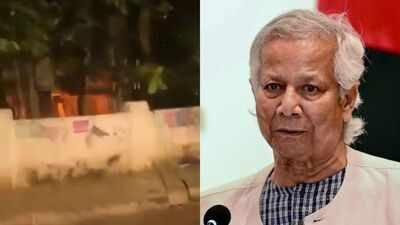
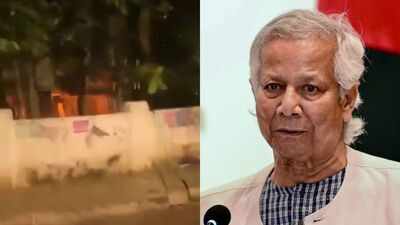
Unidentified attackers on Thursday set ablaze the ancestral home of former interim government chief Muhammad Yunus in Chattogram, as violence intensified across Bangladesh, with crude bomb explosions reported in the capital. The incidents came amid a nationwide shutdown called by the banned Awami League.At least four people were injured in the violence, which involved explosions, arson and vandalism despite heightened security measures. The attacks took place ahead of the “lockdown” called by the Awami League, led by former prime minister Sheikh Hasina, to coincide with the anniversary of a special tribunal verdict that sentenced her to death in absentia last year.Unidentified arsonists targeted Yunus’s paternal residence in the Panchlaish area of Chattogram. The attack followed reports of fires at several branches of his Grameen Bank in different parts of the country, including Sylhet, Rajshahi, Barishal and Faridpur.Police and witnesses reported multiple crude bomb explosions in Dhaka during the early hours of Thursday. Security personnel were deployed at major flyovers, while vehicles were checked at entry and exit points across the capital.The unrest also saw attacks on properties linked to rival political groups. Newspaper reports said suspected activists of Prime Minister Tarique Rahman’s Bangladesh Nationalist Party (BNP) attacked or set fire to the residences of two Awami League leaders in Dhaka.
Security tightened, hundreds arrested ahead of shutdown
Authorities stepped up security across the country, deploying thousands of paramilitary Border Guard Bangladesh (BGB) personnel in sensitive areas, including southwestern Gopalganj district, Hasina’s birthplace.According to BDnews24, police arrested 565 people in a 24-hour operation in Dhaka alone ahead of the shutdown. Among those detained was former education minister Nurul Islam Nahid, who served in Hasina’s cabinet. He was reportedly picked up from his residence around midnight on Wednesday.Police personnel were also deployed at major intersections and transport routes to prevent further violence and monitor suspicious movements.The unrest has spread beyond the capital, with attacks and clashes reported across several districts. Police said two local ruling party leaders were killed in western Narail district after Awami League activists allegedly attacked a BNP street march.Two other people, including a local BNP leader and a transport worker, were killed in separate incidents in southwestern Faridpur and Pirojpur on Tuesday and Wednesday nights.Media reports also said at least two BNP offices and the residence of a party leader were set on fire. In response, at least two Awami League offices and five properties belonging to leaders of the banned party were reportedly torched over the past two days.Dozens of crude bombs were also reported to have exploded, while vehicles were set ablaze in 28 of Bangladesh’s 64 administrative districts.
Tarique Rahman calls for unity against Awami League
Amid the escalating violence, Prime Minister Tarique Rahman appealed to democratic forces to unite against what he described as an attempt by the Awami League to return to power.Describing the banned party as a “terrorist outfit” and a “fallen, defeated, and ousted fascist force”, Rahman called for coordinated efforts to prevent its resurgence.“Let us once again unite in the spirit of 2024, when we drove the autocratic forces out of this country, and ensure that those forces are decisively defeated,” Rahman said in a parliamentary address on Tuesday night.Ahead of his address during the concluding sitting of the current parliamentary session, Rahman met BNP lawmakers and asked them to return to their constituencies to maintain a visible presence on the ground.According to The Daily Star, he also urged party lawmakers not to depend exclusively on government machinery and the administration to counter Awami League activists. Instead, he asked them to coordinate with grassroots leaders and party workers.The BNP’s former ally Jamaat-e-Islami is currently the main opposition party in parliament.Home Minister Salahuddin Ahmed has promised to identify those responsible for the violence and initiate strict legal action against them, using available audio and video evidence.
Why has violence intensified in Bangladesh?
The latest unrest is linked to growing political tensions following the ouster of Hasina’s government in August 2024 and subsequent legal action against the former prime minister and her party.Hasina, 79, has been living in India since August 5, 2024, when she fled Bangladesh following a student-led uprising known as the July Uprising. The movement brought an end to her Awami League government’s tenure after weeks of protests and violence.Bangladesh has since sought her extradition from India.The Awami League called Thursday’s shutdown to coincide with the anniversary of a special tribunal verdict that sentenced Hasina to death in absentia last year on charges of crimes against humanity linked to the crackdown on the uprising.The interim administration led by Yunus, which assumed power following Hasina’s departure, subsequently disbanded the Awami League and initiated legal proceedings against thousands of its leaders and activists. Many were arrested on charges including murder and involvement in violence during the uprising.During Yunus’s tenure, properties and landmarks associated with Hasina’s family and the Awami League were also targeted.Hasina’s father and Bangladesh’s founding leader, Sheikh Mujibur Rahman, had his Dhanmondi residence set on fire and demolished in phases by mobs believed to be supporters of the uprising. Several landmarks associated with the 1971 Liberation War were also vandalised.At the time, Shafiqul Alam, the chief spokesperson of the Yunus-led interim administration, described the mob as a “pressure group”.
Hasina’s planned return adds to political tensions
Political tensions have intensified since July, when Hasina first announced plans to return to Bangladesh voluntarily from India in December, despite the death sentence against her.She said she was willing to return to face legal proceedings, while the Bangladeshi government continued to seek her extradition under a bilateral treaty with India.Her renewed declaration earlier this month that she would return in December at “any cost” reportedly triggered fresh tensions within the country.The latest violence initially erupted in Hasina’s southwestern hometown of Tungipara after dozens of youths suspected of being Awami League supporters were arrested on Tuesday.A local journalist reported that police personnel had vacated a police station after hundreds of people surrounded it. Nearly 30 suspected Awami League activists had been detained there earlier.The attack on Yunus’s ancestral home and the reported arson at Grameen Bank branches mark a new development in the unrest, which had largely involved clashes between rival political groups and attacks on properties associated with the Awami League.With violence spreading across multiple districts, the government faces mounting pressure to restore order as political tensions continue to deepen ahead of Hasina’s proposed return.