








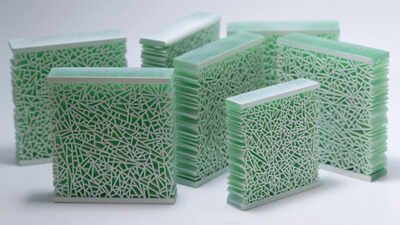
The world around us is built on patterns and networks that often resemble one another. For instance, consider a honeycomb. If you look closely, you will notice a consistent pattern running through its internal structure, made up of repeating hexagonal shapes. But does this repetitive arrangement affect the material’s resilience? Engineers at the Massachusetts Institute of Technology (MIT), USA, have now set out to explore this question.According to MIT News, in a report dated November 11, 2026, engineers at the Massachusetts Institute of Technology (MIT) and Northeastern University have developed a new kind of material whose internal structure is deliberately varied rather than built from one repeating design. This approach could eventually inform the design of protective equipment and packaging.The researchers have introduced what they call “scale-rich metamaterials”. Metamaterials are engineered materials whose properties are shaped not only by what they are made of but also by how their internal structures are arranged. Instead of relying on a single building block repeated across the material, the new design brings together a network of beams that vary in length, thickness and the number of connections they make.The findings of the study were published in Nature on November 11, 2026, in a paper titled “Scale-Rich Network-Based Metamaterials”. The study also reports that these structures can be designed to control properties such as stiffness and the way they respond to force.
What the research entailed
The researchers draw on network science, a field that examines how different points and connections form systems, from the internet and social networks to biological networks in nature. Leaf veins and the veins in dragonfly wings provided examples of intricate natural networks, although the researchers did not simply reproduce the shape of a leaf or wing.Using network principles and an algorithm, the researchers generated a new pattern. It starts by placing a point at a random position and drawing a line through it at a random angle. As more lines are added at different positions and angles, each line stops when it reaches the boundary of the material or intersects an existing line. As this process continues, the lines become progressively shorter and thinner, eventually creating a dense network with features of different sizes.The team then used 3D-printing methods to turn these computer-generated designs into physical samples. According to the MIT report, the researchers deposited polymer in patterns of tiny, interconnected beams. The resulting square samples were approximately the size of a credit card, with internal structures ranging from micrometres to centimetres in scale.The researchers compared the printed materials with conventional lattice and honeycomb metamaterials. They compressed the samples with increasing force and also dropped a heavy weight onto them, recording how each structure responded. The scale-rich networks performed better at resisting compression and impacts in these tests, while their varied internal arrangements helped distribute damage more effectively rather than allowing it to concentrate in one particular region.As MIT mechanical engineering professor Carlos Portela explained, the different sizes of the beams allow the surrounding network to support a structure even if one part fails.
A protective layer inspired by a fruit
The researchers also explored whether this arrangement could be modified to protect something fragile inside a material. In search of an answer, they looked to the pomelo, a citrus fruit known for its thick rind and the variation in density between its outer and inner layers. Inspired by this structure, the team designed a material with a denser network of beams around its edges. A fragile object was placed at the centre, and the researchers tested how well the surrounding structure could shield it. Their design helped divert forces away from the object, showcasing how the density and arrangement of a network could be adjusted depending on what needed protection.
What this could mean for everyday materials
The applications of this research could include objects that need to cushion sudden impacts, such as helmets, protective gear, packaging and armour. The same design framework could also be useful in acoustic lenses, which guide or focus sound and vibrations.However, these possibilities should be understood as potential applications rather than products already ready for everyday use. The findings come from computer modelling and controlled laboratory experiments on engineered samples. Therefore, further research will be needed to determine how these findings could take shape in everyday materials.The study has brought a rather gripping insight, turning an apparent lack of order into a design advantage. Nature’s networks are rarely made up of uniform or repetitive connections, but learning from the myriad structures found in rinds, leaves and wings has brought a new possibility into the field of innovation: exploring how materials can become more resilient without having to make every part of them uniform.