







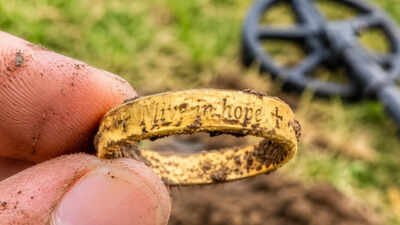
A metal-detecting search in a Warwickshire field led to an unexpected discovery for Kevin Short. Just 15 minutes after beginning the search with his friends, he found a gold ring buried a few inches beneath the soil. The ring carried a short inscription that read, “I live in hope”.Short was surprised by how quickly he found something valuable. The discovery was later examined by the British Museum, which confirmed that the ring was authentic and dated it to between the 16th and 18th centuries. It is now set to go under the hammer at an auction in December, with an estimated value of £2,000 to £3,000.The discovery was particularly exciting for Short, who has been involved in metal detecting for several years. Speaking about the find, he said, “I was genuinely surprised to find something like this so quickly… I knew straight away it was gold, although I had no idea of its quality or how significant it might be.”He told the Banbury Guardian that the search had barely begun when he spotted the ring. “We’d only been searching for around 10 to 15 minutes. I saw it glinting and picked it out from the soil.”The moment became even more memorable when Short and his friends realised what they had found. “When we realised what we’d found, we did the gold dance! It’s certainly not bad for a day’s work,” he said. Short described it as his most exciting discovery after years of metal detecting.The find also came a day after Short had returned another piece of jewellery to someone who had lost it. This coincidence made the discovery of the gold ring even more meaningful for him.
Ring found after an act of kindness
The evening before discovering the gold ring, Short had found an earring while metal detecting. He posted a photograph of it in a metal-detecting group on Facebook, hoping that someone might be able to identify it.The post received an unexpected response. A person contacted him and said the earring looked exactly like one that had belonged to their late sister. The original earring had been lost, and the person believed that Short might have found its missing counterpart.Short offered to send the earring back without asking for any payment. He eventually contacted the owner through Facebook and posted it to them free of charge.The following evening, he found the gold ring in the Warwickshire field. The sequence of events made him wonder whether his earlier gesture of kindness had brought him some good fortune.The ring was discovered only a few inches below the surface. Its inscription, “I live in hope”, was one of the most distinctive features of the find. According to a caption published by the Banbury Guardian, the words appear on the band with crosses separating them. The full inscription reads: “x I x LIVE x IN x HOPE x”.
What makes the gold ring a posy ring?
The gold ring belongs to a category of jewellery known as posy rings. These rings are recognised for their short inscriptions, which are usually engraved on the inside of the band.According to BBC News, such inscriptions are a defining feature of posy rings. National Museums Scotland has also described them as some of the most evocative objects of love in its collections.The words engraved on Short’s ring give it a distinctive character. The message, “I live in hope”, is a short expression, but its original meaning and the person for whom it was intended remain unknown.The British Museum examined the ring and confirmed its authenticity. Its assessment placed the object somewhere between the 16th and 18th centuries. This means the ring could be several hundred years old, although the exact year in which it was made has not been established.There are also unanswered questions about its history. It is not known who owned the ring, who commissioned it or how it came to be buried in the Warwickshire field. Its inscription offers a small clue about the message someone wanted to preserve, but the identity of that person remains a mystery.
Auction estimate puts the ring at up to £3,000
The ring will be offered for sale by Holloways Auctioneers, based in Oxfordshire, on December 2. It has been given an estimated value of between £2,000 and £3,000.Amanda Butler, director at Holloways, said the appeal of such discoveries lies partly in the questions they leave unanswered.“One of the things I love about pieces like this, is that they always carry so many unanswered questions. Who wore it? Was there a special reason for the inscription?” she said, as quoted by British Heritage magazine.She also spoke about the message engraved on the ring and its significance. “‘I Live In Hope’ is such a beautiful sentiment, particularly when you consider that it’s been carried through the generations.”Butler said the ring’s history would probably never be fully known, even though it was interesting to imagine the story behind it. “There’s a whole story here that we’ll probably never know, but it’s lovely to imagine,” she said.