







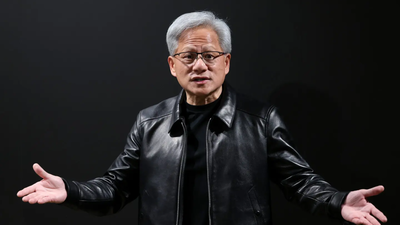
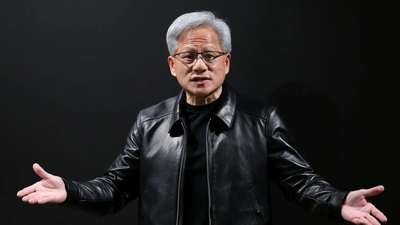
Jensen Huang’s exit as Nvidia boss has added to uncertainty to an already nervous AI market.For months, investors have been questioning whether the AI boom is turning into a bubble. The exit of CEO Jensen Huang has raised fresh concerns about the future of the artificial intelligence bellwether.Nvidia shares plunged 13% at the opening bell, taking the company’s market value below $4 trillion for the first time since July 2025. The fall dragged whole of the Wall Street in red with Dow Jones Industrial Average slipping 50.01 points, or 0.10%, to 52,436.48. The Nasdaq Composite fell 169.62 points, or 0.67%, to 25,296.57, while the S&P 500 declined 37.68 points, or 0.49%, to 7,581.70.The fall comes as investors try to understand what Huang’s departure could mean for Nvidia’s business, its position in the AI industry and the wider technology market.Huang, who co-founded Nvidia and turned it into one of the biggest players in the AI industry, is stepping down as CEO. Chief financial officer Colette Kress will take over as interim CEO while the company looks for a permanent successor, Nvidia said on Thursday.Huang, who owns about 3.61% of the company and is its fourth-largest investor, will also step down from the board.
AI market loses one of its biggest champions
Huang’s exit is significant because his influence went beyond Nvidia. He was one of the most prominent faces of the AI boom, and his departure has left investors wondering whether the leadership change could affect the company’s growth and the wider AI industry.Daniela Hathorn, senior market analyst at Capital.com, UK, said investors were still trying to understand what the change meant for Nvidia.“Investors are trying to figure out what it means exactly for the future of the company. They’re putting someone as an interim just to step in. It’s just a concern about what the leadership transition means for the company, whether it changes much.”The expert further told Reuters, “There’s a key risk here because Jensen was seen as the kind of the front man of AI, not just at Nvidia, but in general. And him stepping down kind of adds a little bit of jitters to the market ahead of the earnings next week and obviously in the middle of this AI rout that we’re going through. So it’s just adds another layer of that kind of uncertainty and concern being piled onto the market.”The timing is also important, with Nvidia’s earnings due next week. Investors are now weighing the leadership change alongside existing concerns about the AI market.
Will AI companies feel the heat
Nvidia’s role in the AI industry is not limited to selling chips. Its business ties with several companies have also raised questions about how smaller players could be affected if the chipmaker changes its approach.Joe Saluzzi, partner and co-head of equity trading at Themis Trading in Chatham, New Jersey, said Nvidia’s role in the industry makes its next steps important for companies that depend on it.“Nvidia has been called the ‘Bank of AI.’ They’ll sell you the chips and loan you the money. If they have to take a step back because of what’s going on, will that cut off funding to smaller companies that need it? That’s an open question.”The supply of chips is another concern. If other chipmakers can meet demand, companies may still be able to continue building data centres and investing in AI. But a shortage could create problems for the industry.“I have heard from some data-center folks that they can buy chips from other companies as long as those companies can supply them. If that’s the case, the AI trade continues, companies keep building data centers, and life goes on. But if there’s a supply shortage, then you have a problem.”
What happens to the AI boom
Huang’s departure has also raised questions about whether the pace of AI development could change. Concerns over how quickly the technology is advancing and whether enough controls are in place have already been raised by Congress and others.Saluzzi told Reuters that the development could slow the industry down and give companies and policymakers time to take stock.“It could also simply slow down the AI machine. Congress and others have raised concerns about the speed of AI development and whether there are proper controls and regulations. Maybe something like this slows it down, lets everyone take a breath, and acts as a kind of regulation without a regulation.”Steve Sosnick, chief market analyst at Interactive Brokers, Connecticut, said the news was difficult for Nvidia and the wider technology market, given how much the AI industry’s expansion depends on the company’s chips.“It’s very difficult to spin this as good news for NVIDIA. It’s difficult for the tech trade right now because not only is NVIDIA’s technology so central to the AI build out, but if this puts a damper on their ability to generate cash flow at the same rate they always have, that becomes tricky.”Sosnick also pointed to Nvidia’s many business arrangements across the industry. He said these ties had raised questions about whether they had made the AI market more stable or more fragile.“The interlocking deals that Nvidia has with so much of the industry raises the question into whether that created more stability or more fragility … There’ll be investigations. The Republicans may not investigate so much, but when you have a new Democratic Congress, I’m sure there will be all sorts of investigations as to whether export controls were violated, whether this was done with the knowledge of the, Department of Commerce and what the State Department knew about this.“
Should Nvidia investors worry
For investors, much will depend on how smoothly Nvidia manages the leadership change and whether it can maintain its business momentum.Colette Kress, who is taking over as interim CEO, is well regarded by investors. However, the challenge is significant, given that Nvidia has been led by its founder since the company was set up.Gil Luria, managing director at DA Davidson, Portland, said Kress should be able to steer the company through the transition, but Huang’s exit leaves a big gap in decision-making.“Colette Kress is well respected by investors and should be able to guide NVIDIA through this challenging period. The task is daunting, as NVIDIA has been founder-led since inception and Mr. Huang concentrated much of the decision making,” Luria said.