







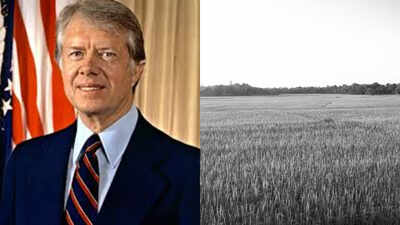
For Jimmy Carter, the 39th U.S. President some of life’s most meaningful moments unfolded far from presidential offices, diplomatic meetings and the demands of public life. They were found among the pine trees, fields and wooded trails of his family’s farmland in Plains, Georgia, where he grew up, worked alongside his father and later returned for moments of quiet with his wife, Rosalynn. Now, nearly 2,500 acres of that cherished landscape are set to receive permanent protection after the Carter family sold the property to a conservation nonprofit for $8.5 million, ensuring that the land will eventually become part of a much larger public wildlife area.
A family property with generations of history
As per reports, the Conservation Fund announced the acquisition on November 9, purchasing approximately 2,458 acres of farmland and forest outside Plains, Georgia. According to The Washington Post, the property had remained closely connected to the Carter family for generations, serving as both an agricultural enterprise and a personal retreat.It is reported that Carter spent his childhood working on the land with his father, James Earl Carter Sr., growing peanuts, cotton and other crops. After leaving the Navy in 1953 following his father’s death, he returned to Georgia to manage the family business.Even after becoming the 39th president of the United States, Carter continued visiting the property. It remained a place where he could escape public attention, walk through the woods, fish in the ponds and hunt turkeys. He also shared the landscape with his children and grandchildren, making it an important part of the family’s history.
Conservation plans for the 2,458 acres
The $8.5 million acquisition is intended to protect the property’s ecological value while making it accessible to the wider public. According to The Hill, the Conservation Fund plans to transfer the land to the Georgia Department of Natural Resources in 2028.The property will eventually be combined with the nearby Lanahassee Creek Wildlife Management Area, expanding the protected landscape to approximately 7,000 acres.The expanded area could begin welcoming visitors as early as 2027, with opportunities for hunting, fishing and other outdoor recreational activities.The land also provides valuable habitat for longleaf pine forests, gopher tortoises, deer, turkeys, quail and numerous other species. People reported that Carter had requested the restoration of the farmland to its more natural state in his later years, including replanting longleaf pine trees.
A conservation legacy beyond the White House
The acquisition also reflects Carter’s longstanding commitment to environmental protection. During his presidency, he signed the Alaska National Interest Lands Conservation Act of 1980, protecting more than 104 million acres. The legislation remains the largest expansion of protected public lands in American history, explains The Washington Post report.As reported by The Washington Post and People, Carter also supported the creation of Georgia’s Chattahoochee River National Recreation Area, established new wilderness protections and installed solar panels on the White House.His former farm and timberland manager, Blake Sullivan, considered the sale a fitting tribute to the former president’s approach to conservation and responsible land management.
Keeping the family’s memories alive
For Carter’s children, the decision to sell the property was closely tied to ensuring that its character and natural surroundings would survive for future generations, adds People report.His daughter, Amy Carter, recalled how the farmland remained her father’s favourite place, even when he could no longer walk through it independently. During his final years, he continued arranging visits, sometimes travelling through the property by car, adds the online report.The Washington Post reported that the Secret Service would often remain out of sight during these visits, allowing Carter to experience the landscape with a sense of solitude. The family ultimately supported the Conservation Fund’s plans, believing that protecting the property and sharing it with the public reflected their father’s values.Images Courtesy: Wikipedia and istock