









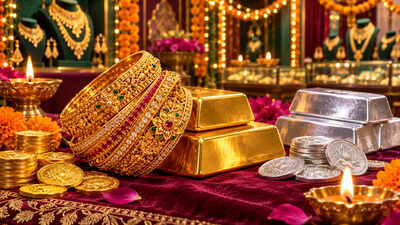
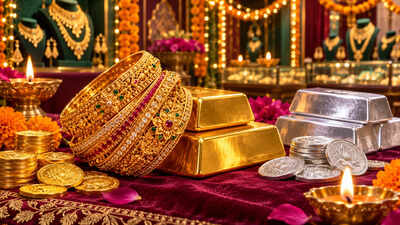
Sone pe suhaga, chandi hi chandi — Indian shoppers might just be having it all this Dhanteras!With Diwali around the corner, gold and silver prices have brought an early surprise for consumers. After a dazzling rally that took both metals to record highs earlier this year, prices have cooled off, giving festive buyers a potential window to make their purchases.And the timing couldn’t be better! For Indian households, Dhanteras shopping has never been just about chasing a good deal. Buying sona-chandi is a generations-old tradition, deeply rooted in the belief that precious metals bring prosperity, good fortune and a little extra sparkle to the year ahead.But before you rush to the jewellery store, there’s a catch.The metals have been on a roller-coaster ride, and with prices fluctuating sharply, buyers are now faced with a dilemma:Should you buy now, or wait for another dip? Is gold the safer bet, or does silver offer better value?
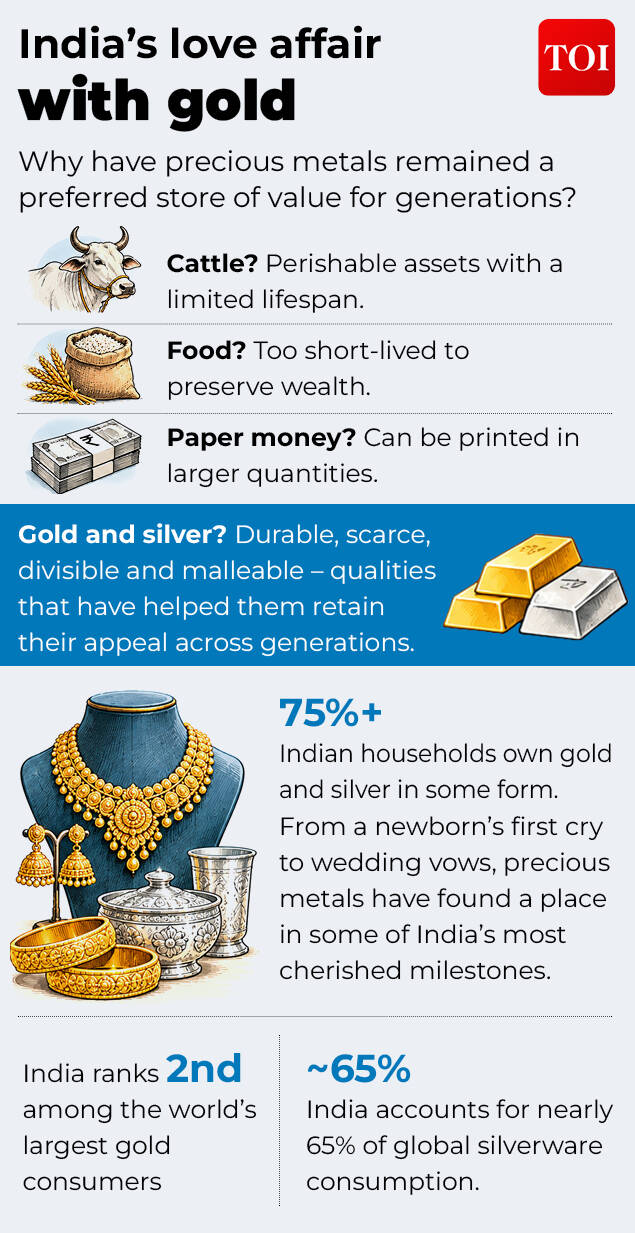
India’s generational romance with gold
Gold and silver prices: How far have they fallen?
After a spectacular rally that took both metals to record highs on January 29, 2026, gold and silver prices have come crashing down, with silver taking the bigger hit.Gold, which touched Rs 1,75,231 per 10 grams, has slipped almost to below Rs 1.5 lakh levels. Silver, which soared to Rs 3,84,632 per kg, has lost nearly half its value and is now hovering around Rs 2 lakh per kg.Internationally too, the yellow metal has faced pressure around $4,000 per ounce, while silver has witnessed sharp swings around $50 per ounce.But what’s behind the sudden fall?For starters, investors began booking profits after the record-breaking rally, putting downward pressure on both metals. Adding to the pressure, the US-Iran war pushed crude oil above $120 per barrel, fuelling inflation fears and concerns that the US Federal Reserve could keep interest rates higher for longer. Higher rates make non-interest-paying assets like gold and silver less attractive than bonds.
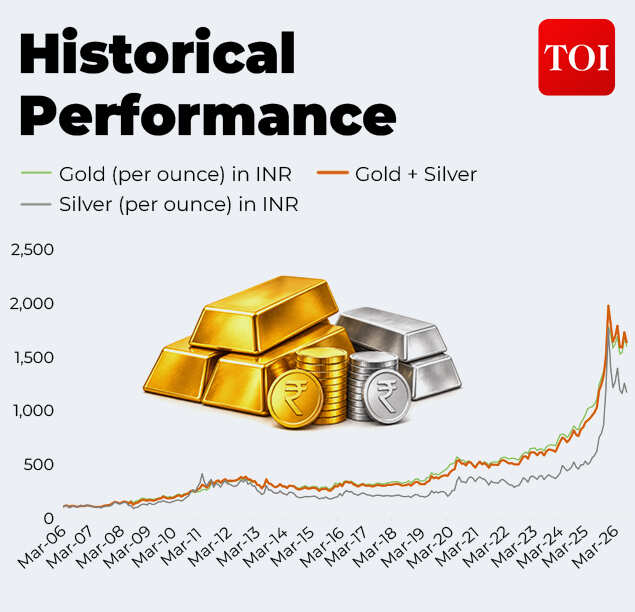
How have gold and silver performed in last two decades (Credit: Motilal Oswal)
Together, profit booking, higher yields and a stronger dollar have weighed on precious metal prices despite ongoing geopolitical tensions.
Gold and silver: What’s next for the shiny duo
Gold and silver have lost some of their shine lately, but is the worst behind us, or is there more drama ahead?According to Vedika Narvekar, research analyst of commodities & currencies at Anand Rathi Shares & Stock Brokers, both metals could face a few more bumps in the short term, but things may look brighter down the road.
Gold: Short-term pressure, long-term promise
The gold could remain under pressure over the next one to two months too. The Fed’s hawkish stance, inflation around 3.7% and Brent crude above $110 per barrel have raised concerns over further monetary tightening. US treasury yields near 5% and the dollar index around 102 could add to the pressure.Narvekar expects gold to trade between $3,950 and $4,200 per ounce internationally, or Rs 1,40,600–Rs 1,48,500 on the MCX.“We see international gold trading in the $3,950–4,200/oz range (MCX Rs 1,40,600-Rs 1,48,500), with downside risk towards $3,800 (MCX Rs1,35,000) if oil prices remain elevated and rate expectations harden,” she told TOI.However, ETF inflows of around $10 billion in September and continued central bank buying could cushion a deeper fall.In the long-term, Narvekar remains bullish, targeting $4,900 per ounce, or around Rs 1.75 lakh on the MCX, by the end of 2027. Central bank diversification, rising US debt, fiscal concerns and possible future interest-rate cuts could support prices.“A sustained recovery will require softer bond yields and a weaker dollar; until then, expect volatility rather than a quick return to record highs,” she added.
Silver: A bumpier ride ahead?
Silver could face an even tougher road. Unlike gold, it isn’t just an investment; it’s also widely used in industries such as solar energy and electronics. That makes prices more sensitive to industrial demand, particularly as solar-panel manufacturers look to reduce silver usage.Narvekar expects silver to test $48–50 per ounce internationally, or Rs 1.70–1.80 lakh per kg on the MCX, amid elevated oil prices, rising yields and the Fed’s hawkish stance.A gradual recovery towards $70 per ounce is possible in 2027, supported by electrification, electronics, data-centre demand and limited mine-supply growth. However, a return to January’s peak of around $122 per ounce, or Rs 4.2 lakh per kg, appears unlikely.“However, weaker solar demand, substitution and the possibility of a smaller market deficit could limit gains,” Narvekar said.For investors, she advised caution rather than chasing a quick rebound.“Investors should therefore treat silver as a higher-risk, higher-volatility holding than gold and accumulate in stages rather than expect a rapid return to peak levels,” she said.
Should you buy now or wait for a bigger dip?
With buying gold and silver being a Dhanteras tradition, the recent fall in prices may come as good news for shoppers, especially as precious metals have consistently delivered double-digit returns through bull and even bear markets.But is it better to buy now or wait a little longer?Experts explain how to time your purchase, what to keep in mind and how much of your money to put into precious metals.Trying to time the market can be tricky, but waiting for a bigger dip could also mean missing an opportunity.Ayush Verma, director of Annapurna Jewellers Pvt. Ltd, Varanasi, said, “While precious metal prices may witness further short-term fluctuations, predicting the exact market bottom is difficult.”Buyers should prioritise affordability, financial needs and investment horizons instead of waiting indefinitely.
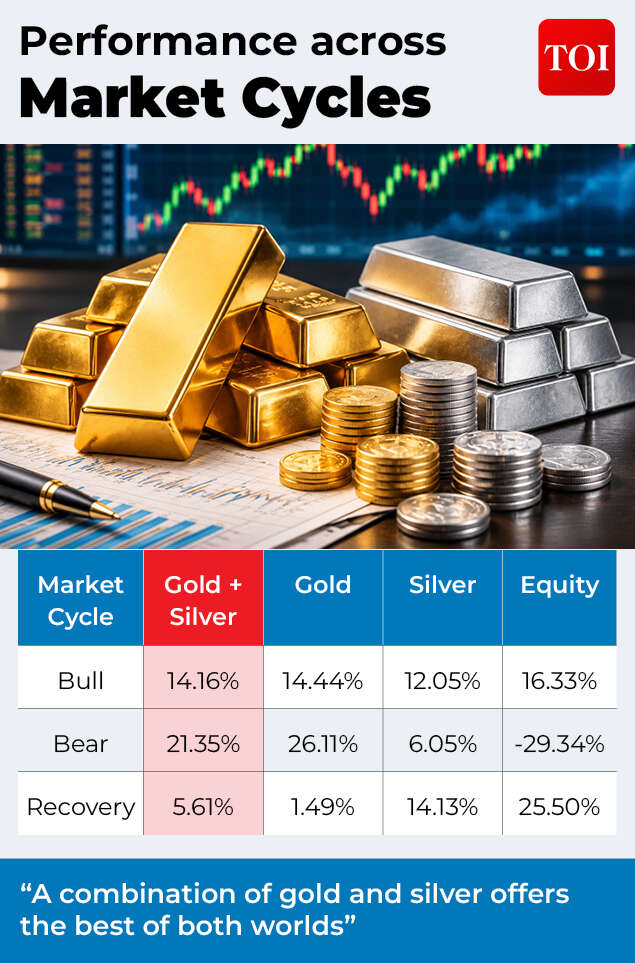
Precious metals offer double digit returns (Credit: Motilal Oswal)
Adhil Shetty, CEO of BankBazaar, views the correction as a natural pause after a sharp rally rather than a sign of a bigger crash. With research reports pointing to higher prices over the coming year, waiting for a steep fall carries risks.“Buying in moderation, rather than trying to time the exact bottom, tends to serve festive buyers better over time,” he said.For those buying purely for investment, Hetal Vakil Valia, jewellery educator, designer and consultant, suggests a measured approach.“Consider investing around 40% to 50% of your planned budget during Dhanteras and keeping the rest liquid,” she said.This allows investors to spread purchases over the coming months and potentially benefit from further dips instead of committing their entire budget at one price.For many, Dhanteras purchases are driven by tradition and sentiment rather than investment returns.Valia believes that the correction offers a more comfortable entry point for festive buyers compared with earlier record highs.
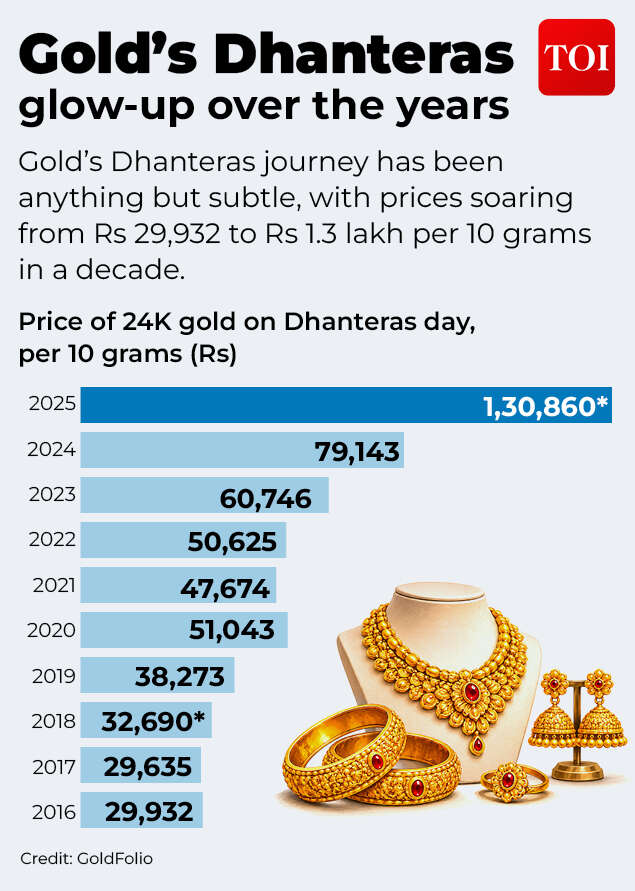
How have gold prices changed over last ten years
Verma also recommends that those buying jewellery or coins for the occasion focus on affordability and personal requirements rather than chasing the lowest price.In short, investors may prefer buying gradually, while festive shoppers can prioritise their needs and budget.
Your 101 guide to shopping gold and silver
With precious metals getting cheaper, filling your Dhanteras shopping basket might seem tempting. But from choosing the right metal to deciding between jewellery, coins, bars and ETFs, there’s more to consider than the price tag.
1. Gold or silver: Play it safe or chase bigger gains?
If protecting wealth is your priority, gold may be the better bet. It’s generally considered relatively stable for long-term wealth preservation and diversification.Valia added, “If you are comfortable taking on more risk in pursuit of higher returns, silver is worth considering.”But then, why choose just one?“A balanced approach could involve gold as the core precious metal holding, complemented by a smaller silver allocation for diversification,” Verma told TOI.This could combine gold’s relative stability with silver’s growth potential while limiting exposure to the more volatile metal.
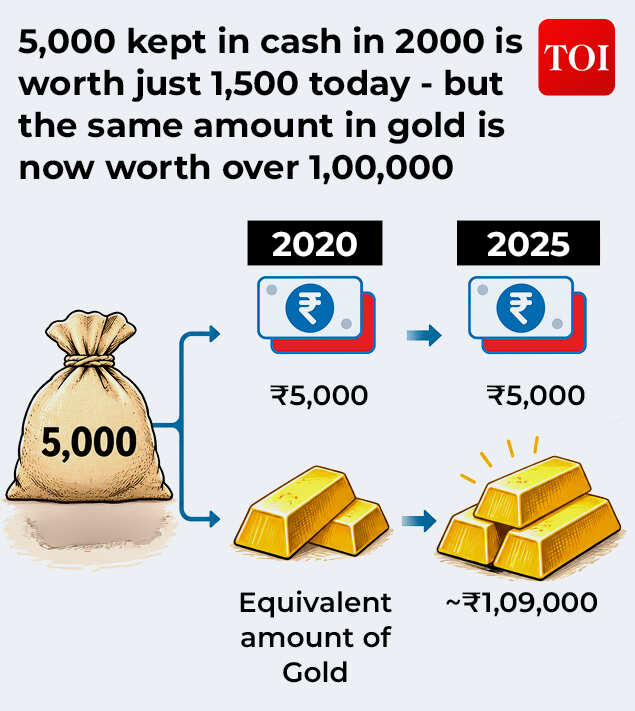
Rs 5,000 then vs now: How gold has outshone cash over the years
2. Jewellery, coins or bars: What’s the smarter investment?
Buying precious metals doesn’t necessarily mean buying jewellery. For those investing purely for returns, coins and bars may be more cost-effective.Shetty said, “Coins and bars work out cheaper than jewellery once making charges and resale cuts are counted in, making them the better route for pure investment.”Valia points out that making charges can range from 10% to 20%, affecting resale returns.Jewellery, however, offers value beyond its price tag, from craftsmanship and heritage to gifting and personal enjoyment.So, while jewellery may suit festive and personal purchases, coins and bars could make more sense for investment-led buyers.
3. Digital Dhanteras portfolio
Don’t want the hassle of storing precious metals? ETFs let you invest in gold or silver without holding them physically, while electronic gold receipts give you ownership of gold stored in approved vaults.“Gold and silver ETFs skip storage and purity concerns altogether, and suit buyers who want exposure without holding the physical metal,” Shetty said.However, investors should compare brokerage, fund expenses, liquidity and market risks.And while ETFs and electronic gold receipts are regulated by SEBI, not every digital gold product has the same regulatory oversight.
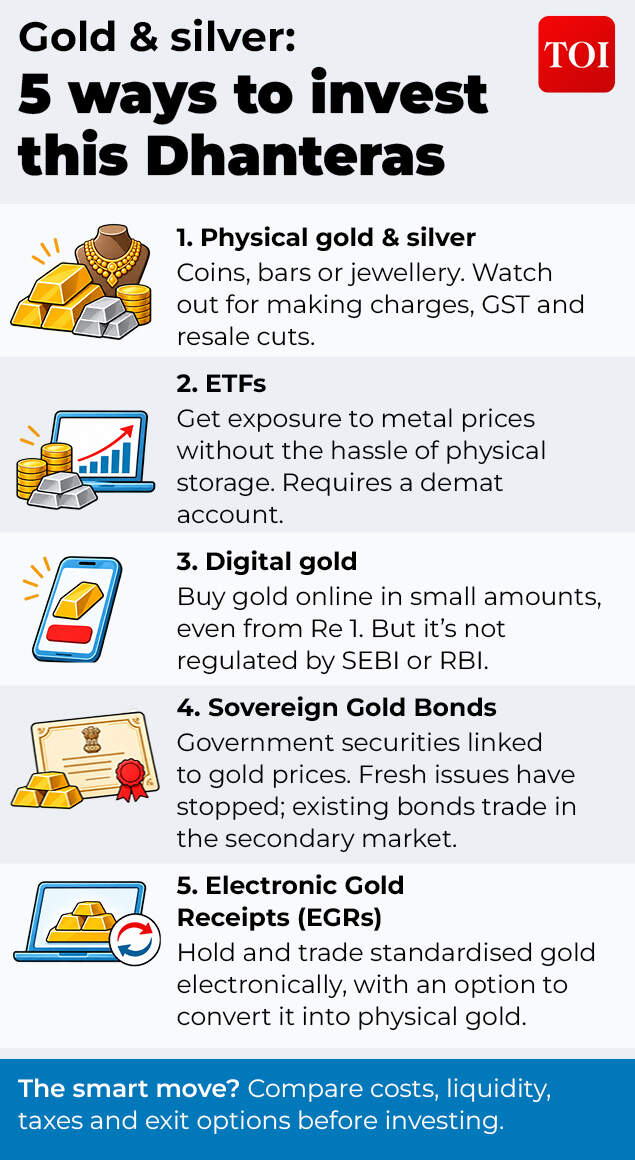
Investing in gold and silver this Dhanteras
4. Buying it for the bling ? Keep these tips in mind
If jewellery is on your shopping list, look beyond the glitter!Verma advises checking design, purity, hallmarking and transparent making charges before purchasing.Remember, the quoted gold rate isn’t necessarily the final bill. Making charges and other applicable costs can add to your expenses, while resale terms can affect how much you recover later.Those buying coins and bars should also compare purchase costs and resale options.
5. No thumb rule!
Afterall, not every Dhanteras purchase needs to be an investment! Jewellery may be bought for wearing, gifting or passing down through generations, while investment purchases focus on potential returns.As Shetty explained, “Which metal makes more sense usually depends on the buyer’s purpose rather than one being clearly ahead.”Ultimately, the right choice depends on whether you’re shopping for tradition, enjoyment or long-term returns.
How much gold and silver should you buy
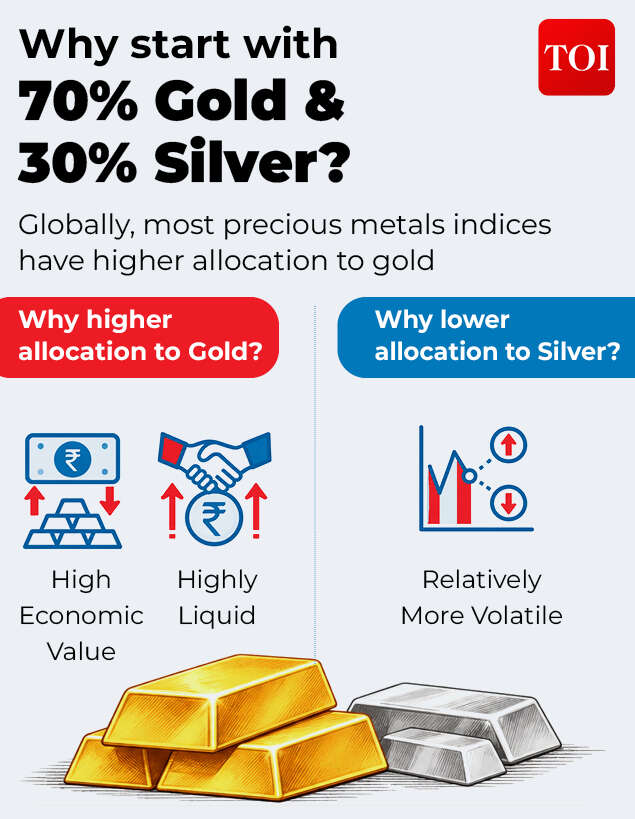
Gold for stability, silver for opportunity: Why the 70:30 split?
Gold and silver can add some shine to your investment portfolio, but going overboard may not be the smartest move. And when it comes to the ideal amount to invest, experts have different takes.Verma recommends keeping around 5–15% of an investment portfolio in precious metals, depending on financial goals, risk appetite and existing holdings.Shetty suggests a more conservative benchmark. “Many financial planners suggest keeping gold in the 5% to 10% range, as a broad rule of thumb that varies by household,” he said.Valia recommends allocating 10–25% of total household savings to precious metals, depending on individual circumstances, with gold forming the larger share.“I would generally favour a 70:30 or 80:20 split between gold and silver, keeping gold as the larger component because of its relatively stable role in wealth preservation,” Valia said.However, precious metals should complement, not replace, investments such as equities, bonds, fixed deposits and cash reserves.
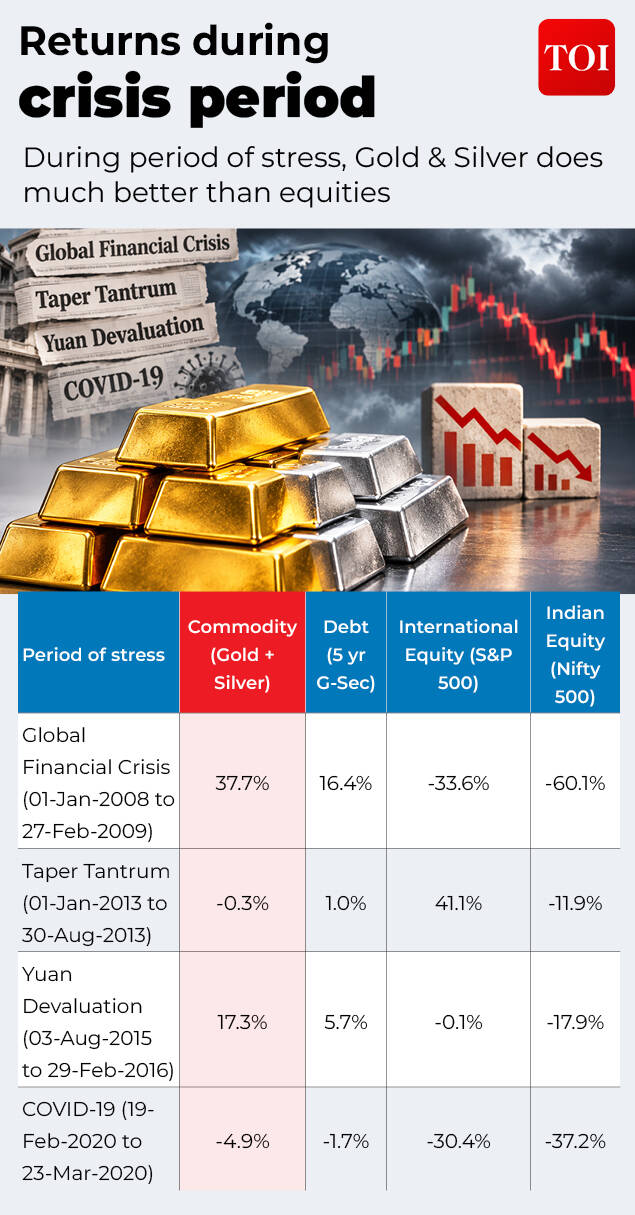
Precious metals vs equities: What gives better returns in times of crisis (Credit: Motilal Oswal)
The bottom line
Whether you’re buying for tradition or investment, don’t let the festive glitter outshine financial sense.Rather than chasing the perfect price, experts suggest spreading your purchases over time. As Shetty puts it, “Buying a little at a time helps smooth out price swings instead of committing it all at once.”If you’re bringing home physical gold or silver, look beyond the price tag. Check purity, hallmarking, making charges and buyback terms.Prefer ETFs? Keep an eye on fees, market risks and regulatory safeguards. Avoid borrowing to invest!After all, while precious metals may help protect your wealth, they don’t earn interest or dividends. So, before splurging on that festive sparkle, make sure your emergency savings, insurance and essential financial goals are taken care of.A little sona-chandi can certainly add shine to your portfolio, just make sure it doesn’t eat up all your savings!(Disclaimer: Recommendations and views on the stock market and other asset classes given by experts are their own. These opinions do not represent the views of The Times of India)