









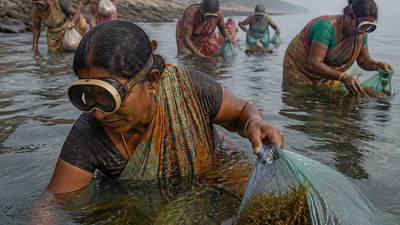
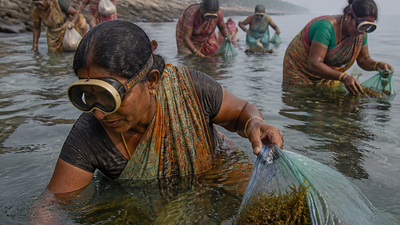
Before the sun fully rises, and while most of us are still tucked under blankets, near the corner of the Indian Peninsula, a group of women walks toward the sea wearing sarees, not diving suits; then they take a breath, hold it, and disappear beneath the water.But why?For pulling out seaweed!We often think of heroes as people with loud announcements or massive titles. Yet some people do the most important work far from the cameras, and they rarely get thanked.Such are these women, saree-clad seaweed farmers from Rameswaram, who walk into the sea each day and pull out these essential plants
Meet the Saree-Clad Seaweed Women of Rameswaram
At the far end of the Indian peninsula, women dive into the sea for a living, wearing sarees and carrying little more than borrowed goggles. They pluck seaweed that grows on underwater rocks and dead coral reefs near the islands of the Gulf of Mannar, and to protect their hands, they do nothing much but wrap a cloth around their fingers and hold it in place with rubber bands.According to The Better India, the skill runs in families, and their mothers, grandmothers, and great-grandmothers did the same work for years. These women have faced a tsunami, a government ban on seaweed collection, and poverty, and are known as the guardians of the Gulf of Mannar’s marine environment.However for the work that these women do, they work is quite challenging due to the lack of amenities and resources. Just like hundreds of saree-clad women before them, women from the coastal villages of the area still depend on seaweed collection to earn a living. With only a plastic sack tied around the waist and a basic diving mask, they head into the sea every day, even though the work is risky and absence of a hospital nearby, according to the Mongabay India.
These seaweed farmers lack amenities
Photographer Raajadharshini first learned about this community by chance, from a scrap of newspaper that her food had been wrapped in. That small piece of paper stayed with her, and she has since made it her mission to share the women’s story.She also wants people to see how badly they need better protective gear as the climate becomes harsher and harder to predict, according to a report by We Present, the photographer reverals that the struggles these women face from forces they cannot control, and its the moments of laughter and togetherness that help them keep going.The Gulf of Mannar became a Marine National Park in 1986, and a ban on seaweed collection followed and the areas around the islands, home to dugongs and coral reefs, became off-limits for local communities.According to the Better India, this has impactyed the livelihood of the families dependant on these women for survival.Lakshmi Moorthy, a 48-year-old woman of Chinnapalam village said, “My family cannot eat if I do not go to the sea”, who has been collecting seaweed since the age of seven.
Why is seaweed important to the economy?
Compared to the food we grow on land, seaweeds are packed with nutrition. According to a study in the International Journal of Pharmacy and Pharmaceutical Sciences, They are rich in vitamins, minerals, proteins, healthy fats, and natural plant compounds, along with enzymes and trace elements. People have used them for a long time as food, animal feed, medicine, cosmetics, fuel and fertiliser.They are also used in factories to make agar and alginate, which go into many everyday products. More recently, they have found a place in poultry farming because of their nutritional value. Seaweeds are even being used to clean polluted water by reducing harmful nitrogen and phosphorus.