







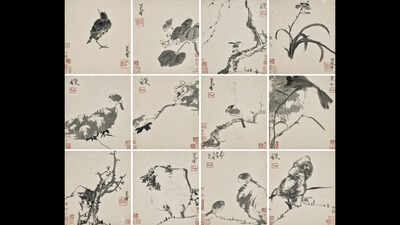
Nature’s longest affair is perhaps that between birds and flowers. The birds cling to the flowers, drinking their sweet nectar like a thirsty man who has finally found water in the desert. And all the flowers ask in return is that the birds carry their seeds far and wide, allowing new life to take root. It is a relationship that has existed for centuries, one that has inspired poets, painters and storytellers across cultures.Bada Shanren was one painter who found extraordinary beauty in this seemingly ordinary relationship. His subjects were often no more than birds perched on branches, flowers in bloom, fish swimming in ponds and rocks resting in an otherwise empty landscape. Yet, he captured their essence in a way few artists could.In the early spring of 1699, Bada Shanren painted Flowers and Birds, an album of twelve ink-on-paper leaves. At 73, he had reached the height of his artistic maturity. More than three centuries later, the album made headlines when it sold for HK$61.9 million (approximately Rs 75 crore) at Christie’s Hong Kong on October 27, 2026. But the story of these twelve leaves begins much earlier, with a royal descendant who abandoned his former life to become a Buddhist monk.
Who was Bada Shanren?
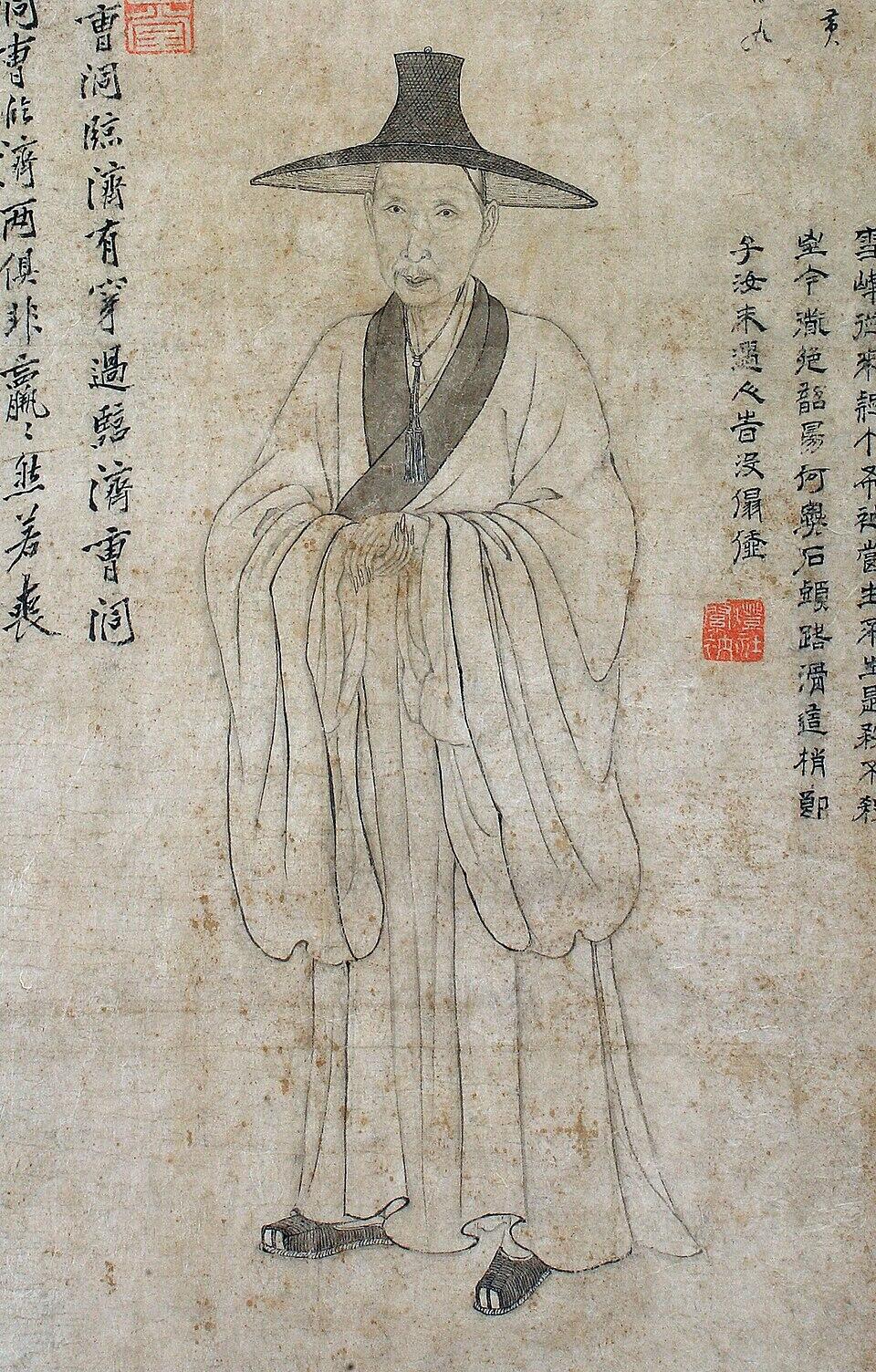
Image sourced from Wikimedia Commons
Born Zhu Da in 1626 in Nanchang, in China’s Jiangxi province, Bada Shanren belonged to a branch of the Ming imperial family. His childhood was steeped in art and literature, and he showed an early aptitude for poetry, painting and calligraphy. However, his life took a dramatic turn in 1644, when the Ming dynasty fell to the invading Manchu forces, bringing an end to nearly three centuries of imperial rule.As a member of the former royal house, Zhu Da faced an uncertain future under the new Qing dynasty. He sought refuge in a Buddhist monastery, where he lived as a monk for nearly three decades. Around 1680, he left the priesthood and returned to secular life, eventually establishing himself as a professional painter and calligrapher. It was during this period that he adopted the name Bada Shanren, under which he would become one of China’s most distinctive artists.His paintings were often sparse, leaving large portions of the paper untouched. Flowers, branches, fish and birds emerged from a few deliberate brushstrokes, with the surrounding emptiness becoming as important as the subjects themselves. Beneath their seemingly uncomplicated appearance, however, his works carried a sense of melancholy, solitude and, at times, a quiet resistance to the world around him. His loyalty to the fallen Ming dynasty is also believed to have shaped some of the symbolism in his art.
What was Flowers and Birds about?
Created during his late Lotus Garden Period, Flowers and Birds brings together 12 individual compositions featuring the namesake, fish and rocks. Each leaf measures approximately 30.5 by 27.5 cm and is painted in ink on paper. Rather than filling the surface with intricate details, Bada allowed each subject to occupy its own space, making the simplest of compositions feel remarkably expressive.Among the subjects are plum blossoms, orchids, lotus flowers, bamboo, chrysanthemums, lilies and birds perched among branches. There are also depictions of a myna, an old tree and two birds. The compositions are held together by his distinctive brushwork, which shifts between delicate, almost fleeting strokes and darker, more assertive marks.Perhaps the most recognisable feature of Bada’s bird paintings is their unusual eyes. Often turned upwards or positioned at an angle, their gaze gives the birds an almost human expression. They appear watchful, aloof and occasionally suspicious, as though observing the world without quite wishing to participate in it. It is a small detail, but one that gives these otherwise simple subjects an unmistakable personality.He highlights using the empty space itself. A bird does not need an elaborate landscape behind it, nor does a flower need a crowded garden to appear complete. The untouched paper becomes part of the composition, allowing the viewer to pause and look closer. This restraint, combined with his expressive brushwork, is what makes Bada’s paintings so distinctive.
Where is the painting now?
The album’s journey through the hands of collectors is almost as remarkable as the artwork itself. It was first recorded in the collection of Pan Zhengwei, a prominent Qing-dynasty collector, in his Record of Paintings and Calligraphy in the Tingfanlou Collection. Pan admired Bada’s exquisite brushwork and ink effects, noting that the paintings were originally accompanied by ten additional leaves of calligraphy.The album subsequently passed through the collections of Wang Kemin and Zhang Zhiqin before entering the celebrated Dafengtang collection of Zhang Daqian, one of China’s most renowned modern painters and collectors. It later belonged to Wang Fangyu, a Chinese art scholar and professor at Yale University, and his wife, Sum Wai. The couple assembled one of the most significant private collections of Bada Shanren’s works.In 1990, Flowers and Birds was exhibited at the Asian Art Museum of San Francisco as part of Master of the Lotus Garden: The Life and Art of Bada Shanren. It travelled to the Yale University Art Gallery in 1991, where it was also featured in the accompanying exhibition catalogue.That same year, the album appeared at Christie’s New York’s Fine Chinese Paintings and Calligraphy auction on November 23, as Lot 130. It subsequently passed through E&J Frankel Ltd in New York before being acquired by its next owner in 2020.Its latest appearance was at Christie’s Hong Kong in October 2026, where it sold for HKD 61.9 million, more than five times its lowest estimate of HKD 12 million. The buyer has not been publicly identified, and the album is now understood to have entered another private collection.Three centuries after Bada Shanren first put brush to paper, his 12 leaves continue to travel, finding new admirers across generations. Perhaps that is the beauty of his work: he depicted ordinary things in an extraordinary manner through his paintings.