









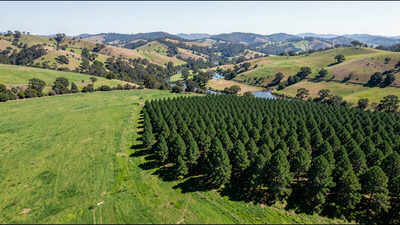
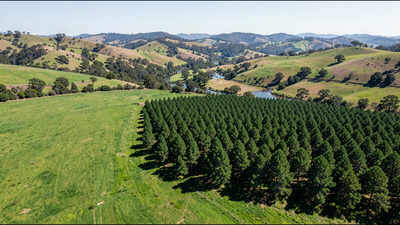
Converting grazed pasture to pine plantation can significantly reduce the amount of water flowing through streams, according to a hydrological modelling study of 2 afforested catchments in New Zealand’s Waikato region. Published in Journal of Hydrology: Regional Studies in 2024, the study, titled Modelling the hydrological impact of afforestation in hill country catchments in New Zealand, used the Soil and Water Assessment Tool (SWAT) to estimate the effects of land-use change. The researchers, Linh Hoang and Andrew Hughes, modelled a 29.7% reduction in mean annual streamflow in Mangaotama, where approximately 57% of the catchment was afforested. In Kiripaka, where about 9% was afforested, the modelled reduction was 4.7%. A third catchment, Whakakai, served as a native-forest control and had no land-use change. Increased evapotranspiration and reduced surface runoff were the main mechanisms behind the modelled decline. However, the size and timing of the changes varied, highlighting the need to consider model uncertainty when assessing the hydrological effects of plantation forestry.
How researchers modelled pine afforestation in two Waikato catchments
Hoang and Hughes examined 3 hill-country catchments in the Waikato region, but only 2 underwent pasture-to-pine conversion. Mangaotama was approximately 57% afforested, while Kiripaka was about 9% afforested. Whakakai, which was covered by native forest, served as a control catchment without land-use change. Whakakai had no land-use change and served only as a native-forest control. The modelled streamflow reductions applied to the 2 afforested catchments, with a larger estimated effect in Mangaotama than in Kiripaka. The researchers used SWAT, a hydrological model that simulates how water moves through a catchment, to compare modelled streamflow under scenarios with and without land-use change. They evaluated the model against observed streamflow data from before and after the change. According to the paper, SWAT reproduced the magnitude, timing and variation of streamflow at daily and monthly scales, allowing the researchers to investigate how much of the observed change could be associated with afforestation.The best-fit model results indicated a 29.7% reduction in mean annual streamflow in Mangaotama. However, the estimated effect varied across the behavioural parameter sets, which represent different model configurations that met the researchers’ performance criteria. Across these sets, the median reduction was 20%, with a range of 12% to 32%. In Kiripaka, the modelled reduction was 4.7%. These differences show that the estimated hydrological effect varied with the extent of afforestation and the parameters used in the model.The researchers also identified limitations in the model’s representation of forest growth. SWAT produced a streamflow reduction immediately after planting, whereas observations showed a more gradual decline over approximately 7 years. The authors attributed this discrepancy to limitations in the model’s forest-growth representation. The model also overestimated post-change increases in streamflow in the other 2 catchments. In Whakakai, it predicted an increase of 24%, compared with an observed increase of 11%. In Kiripaka, it predicted an increase of 10.5%, while the observed change was approximately a 1% decline. These differences are important when interpreting the precision of the modelled estimates.
Why pine plantations can reduce streamflow
The 2024 study identified increased evapotranspiration and reduced surface runoff as the main reasons for the modelled decline in streamflow. Evapotranspiration combines water evaporating from land and vegetation with water absorbed by plants and released into the atmosphere. Replacing short pasture with trees changes how rainfall is intercepted, stored and returned to the atmosphere, potentially leaving less water available to reach streams. The model also indicated a decline in groundwater flow in Mangaotama. Across the behavioural parameter sets, the median reduction was 30%, and more than 75% of the sets showed a decline. In Kiripaka, the median change was approximately −1%, indicating little overall change and considerable uncertainty about the direction of the effect. The findings therefore suggest a clearer modelled groundwater decline in the more heavily afforested catchment, rather than a uniform response across the study area.An earlier field study provides the observational evidence against which the later model was evaluated. Published in the New Zealand Journal of Marine and Freshwater Research in 2020, “The stream hydrology response of converting a headwater pasture catchment to Pinus radiata plantation” examined 23 years of data from Mangaotama, a steep pastoral catchment in the western Waikato. The researchers reported that approximately 62% of the catchment had been planted with pine. This differs slightly from the approximately 57% afforestation used in the 2024 modelling study. Seven years after planting, annual runoff was 380 mm lower than the researchers predicted it would have been if the catchment had remained in pasture. The 2024 model estimated a 29.7% reduction in mean annual flow for Mangaotama, broadly consistent with the approximately 32% reduction reported by the earlier field study. Because the 2020 observations were used to evaluate the later model, this agreement represents validation against field data, not independent confirmation from an unrelated catchment.The 2020 study also reported that peak flows fell by approximately 50%, while low flows appeared to decline by about 25%. The authors described the low-flow result as less clear. They linked the changes in peak flows and stormflow largely to canopy interception, which can reduce or delay the amount of rainfall reaching the ground. After 2 phases of plantation thinning, the difference between measured runoff and the pasture-based prediction narrowed to 129 mm, indicating that the hydrological response also changed with plantation management.
What the Waikato findings mean for water and catchment management
The studies show that converting pasture to pine plantation can alter the amount and timing of water flowing through streams. However, they do not establish that the same reduction will occur in every plantation or catchment. The modelled decline was substantially larger in Mangaotama, where afforestation was more extensive, than in Kiripaka, where only about 9% of the catchment was afforested. The implications for low flows also require caution. The 2020 field study suggested that low flows may have declined, but its authors described the result as less clear. The 2024 modelling paper likewise found that changes in baseflow were less consistent than changes in overall streamflow. The evidence therefore does not justify a general claim that pine afforestation will necessarily reduce low flows by a particular amount.The findings apply specifically to pasture-to-pine conversion in the catchments studied. They should not automatically be extended to other types of forestry, different land-use transitions or all catchments in New Zealand. The model’s limitations in representing forest growth and the uncertainty across parameter sets also affect how precisely the results can be applied elsewhere. For landowners and regional planners, assessing potential effects on water yield and interpreting model predictions alongside long-term streamflow measurements are reasonable considerations when evaluating proposed land-use changes. The study demonstrates the value of hydrological modelling, while also showing why model assumptions, field observations and local catchment conditions matter when estimating the effects of afforestation.