








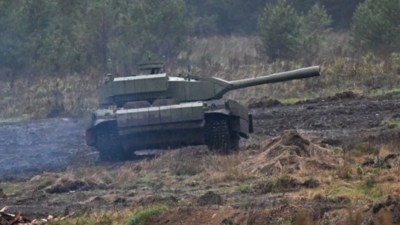
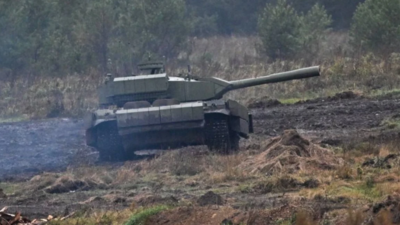
Russia has fielded an unmanned tank called Shturm, which means assault, which was revealed at Center-2026, one of the large exercises the Kremlin holds periodically alongside Vostok, Zapad and Kavkaz. The Shturm heavy assault robotic system is based on the T-72, which the Indian Army also operates in large numbers. It is meant to breach fortified defensive lines and fight in urban areas. Testing was first reported only in July 2025, and the vehicle has been in development for roughly 15 years. Russia has now brought it at least to an initial level of readiness for operational use.The system pairs remotely operated combat vehicles with a separate crewed command vehicle, built on a T-72 or T-90 chassis and described as a mothership tank. Operating either the unmanned tank or the BMPT requires three operators, who remain inside the command vehicle. The two vehicles are meant to stay within direct line of sight, at a range of roughly three to four kilometres. The main Shturm configuration carries a shortened 125 mm gun intended for urban operations, along with a bulldozer blade and additional armour to improve protection against infantry anti-tank weapons.The Indian Army is working along similar lines. It is converting T-72 tanks into remotely operated vehicles, which is to be done through IP-based interfaces, with the aim of operating them in a manned-unmanned teaming framework, in which crewed and uncrewed assets work together to multiply combat power. The Army is seeking domestic partners to digitise the Soviet-origin platform, and has opened the challenge to industry through the Innovations for Defence Excellence’s (iDEX) Aditi 4.0 programme. The IP-based interface is meant to provide a secure, resilient connectivity in contested environments, which will be resistant to jamming and cyber intrusion.The unmanned T-72s are envisioned for high-risk missions, including breaching minefields, acting as decoys to draw enemy fire, spearheading assaults, reconnaissance and patrolling in contested zones. The digitised tanks will feed real-time data into command networks, while operators and commanders retain decision authority. The Army expects manned-unmanned teaming to let it generate combat mass without exposing tank crews to lethal threats, improving survivability, tempo and operational flexibility.The T-72 has been in Indian service since 1979 and has operated across varied terrain, from the plains of Punjab and the deserts of Rajasthan to high-altitude sectors and the jungles of Sri Lanka. Successive upgrades have kept it effective, and converting it into an unmanned vehicle offers a cost-effective way to extend its life. Unlike the US and China, which are investing in entirely new platforms, India is repurposing legacy armour, in line with its push for indigenous defence innovation.Other militaries are also testing the same idea, China’s Type 100 Smart Tank integrates AI-driven navigation, lidar and modular armour, and is designed to work with other robotic platforms and manned vehicles. Australia’s Autonomous Tactical Light Armour System Collaborative Combat Variant (ATLAS) has demonstrated autonomy ranging from remote control to autonomous navigation, with a turret that automates detection and engagement.