







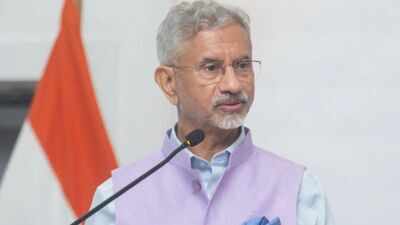
NEW DELHI: External affairs minister S Jaishankar has said that India and the United States were continuing talks to resolve differences over the proposed trade deal, adding that negotiations appeared to be heading towards a “landing point”.He also said the core fundamentals of the bilateral strategic partnership remained unchanged. “I think we are waiting on a few things. I wouldn’t be comfortable spilling the beans in public,” Jaishankar said at the Bloomberg New Economy Forum on Tuesday evening when asked about the status of negotiations, PTI reported.“When countries negotiate with an economy like the United States, obviously one part of it is what you work out between yourselves and the US, and one part of it is how do you fare vis-a-vis competitive economies,” he added.He said the outcome would also depend on the terms other countries secured in their negotiations with Washington.“And that part of it is not entirely clear because not everybody has worked out a deal. I think people, the trade ministers, USTR (US Trade Representative) there and our Commerce and industry minister are there working on that. They’re ironing it out,” he said.“My sense is that this is an issue which is heading towards a landing point,” Jaishankar added.His remarks came more than a week after finance minister Nirmala Sitharaman said negotiations on the India-US trade agreement had reached a “plateau”.Goyal says India-US ties are ‘very good’Commerce and industry minister Piyush Goyal said India-US relations were “very good” and would continue to improve regardless of changes in political thinking in either country.“Of course, it is already very good. I don’t see any problem as we speak also. And to my mind, the relationship with the US that India enjoys is very substantive, very consequential for the world, being two large democracies,” Goyal said at the Bloomberg New Economy Forum on Wednesday.He was responding to a question on whether bilateral relations would improve after US President Donald Trump leaves office.Goyal said the relationship extended beyond trade to defence, technology, critical minerals and people-to-people ties.“One must bear in mind that we have, it’s not only about trade, which of course they are our largest trading partner and I think will continue to be in the years to come. And by and large, I don’t see any problem in any agreements also with the United States,” he said.Goyal added, “It’s about trade, it’s about defence partnership, it’s our technology partnership, it’s our critical minerals partnership, it’s our people-to-people engagement”.He said both countries continued to engage closely on defence exercises and efforts to maintain open supply chains for technology, goods and services.“The US and India have a very, very consequential relationship and it’s only going to get better irrespective of changes in political thinking, whether in India or in the US. The relationship draws its strength from our economic imperatives, from our political imperatives, from our security imperatives,” he said.“So it’s a very safe relationship. I don’t think the rest of the world needs to worry about it,” he added.India and the US have been negotiating a proposed bilateral trade pact since early 2025 to address tariff-related tensions, remove non-tariff barriers and improve market access.India is seeking more favourable tariff terms for its exports to the US compared with those offered to competing economies.Earlier this month, US Trade Representative Jamieson Greer said the two countries were working to finalise a trade deal, but an agreement was not imminent. He said both sides had identified the outstanding issues and were working towards resolving them.‘We are not officially an ally’Jaishankar said Washington’s approach to economic engagement had changed, with tariffs forming part of a broader effort to revive domestic manufacturing and reset access to the US market.“The US has a fundamentally different approach to the use of tariffs. But even that is a symptom of something else. The US is today determined to re-industrialise and to reset the terms of access to its economy,” he said.“That’s what the whole tariff debate is about. And the two are connected: access to the American economy and the re-industrialisation of America. Therefore, what is happening is every significant economy is getting into a negotiation with the United States on this issue,” he added.Jaishankar said India was not alone in negotiating with Washington and that its discussions were at an advanced stage. “We’re not alone in this. In our case, we are pretty far advanced in that process of negotiation,” he said.Jaishankar also discussed Washington’s changing approach to alliances and treaty relationships, saying the impact was being felt most strongly in Europe and, to some extent, in East Asia.He said India’s relationship with the US was different because the two countries were strategic partners, not formal allies.“We have many issues we are working on with the United States, but we don’t have an issue of the terms of alliance because we are not officially an ally.”“We are a country which has a strong strategic partnership with the US, but a strategic partnership is a partnership; it’s not an alliance,” he added.Jaishankar said the two countries had spent more than two decades identifying areas of convergence and shared interests.“In our case, for the last 20-odd years, we have worked out what we felt were convergences, overlaps, shared common interests with the US, and we had agreed that we would pursue that. I don’t think that has fundamentally changed,” he added.India-US relations have faced a downturn following Washington’s imposition of punitive tariffs on Indian goods last year.Changes to US immigration policy and an increase in H-1B visa fees further strained ties.Relations came under fresh pressure after Washington moved to restrict a key green-card processing programme affecting major global and Indian IT firms, including Tata Consultancy Services and Wipro.Despite the tariff pressures, India’s exports to the US rose marginally by 0.92% to $87.3 billion in the 2025-26 fiscal year. Imports from the US increased 15.95% to $52.9 billion. As a result, India’s trade surplus with the US narrowed to $34.4 billion in 2025-26 from $40.89 billion in 2024-25.