








India is heading into winter with a worrying combination: a monsoon that delivered nearly 13 per cent less rain than normal and an El Niño that could become one of the strongest on record by December.With the southwest monsoon now over, attention is shifting to the months ahead. Will India experience a warmer-than-usual winter? Could the rainfall deficit affect water supplies and rabi crops? And could the strengthening El Niño increase the risk of extreme heat during the summer of 2027?The concern is not just about temperatures or rainfall. It extends to agriculture, water availability, electricity demand and public health, as the country prepares for the possible effects of an exceptionally strong El Niño.The larger weather story is unfolding thousands of kilometres away, over the equatorial Pacific Ocean. There, an intensifying El Niño is expected to influence global temperatures and rainfall patterns for months to come.
What makes El Niño ‘super’?
To understand why a patch of unusually warm water in the Pacific can matter to a farmer in India or a power grid operator in Delhi, it helps to start with the ocean–atmosphere system that normally keeps tropical weather patterns in motion.Under normal conditions, trade winds push warm surface water westwards across the tropical Pacific towards Indonesia and Australia, while cooler, nutrient-rich water rises near South America. This temperature contrast drives the Walker circulation, a system of rising and sinking air that influences tropical rainfall.El Niño develops when trade winds weaken and warm water spreads eastwards, shifting atmospheric circulation and rainfall patterns worldwide. It is the warm phase of the El Niño–Southern Oscillation (ENSO), a natural climate pattern that also includes cooler La Niña conditions and neutral phases. ENSO typically recurs every two to seven years.“Super El Niño” is an informal term for an exceptionally strong event, not an official category.In its October 8, 2026 outlook, the World Meteorological Organization forecast a Niño-3.4 sea-surface temperature anomaly of approximately +3.7°C during October–December, potentially exceeding the 2015–16 peak of +2.6°C. NOAA projected an 83 per cent or greater chance of strong-to-very-strong conditions persisting through January–March 2027.
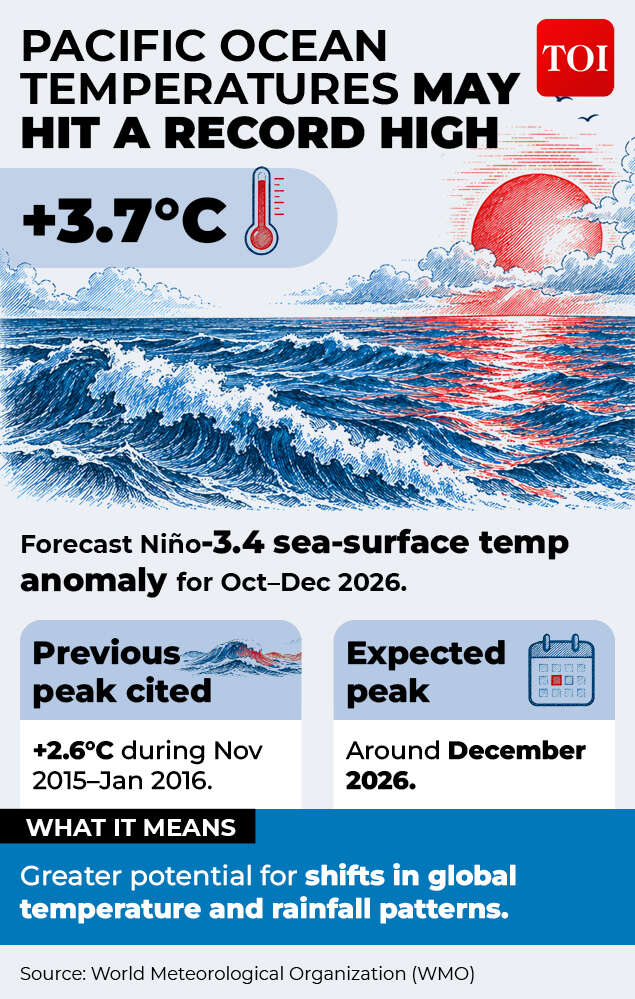
Pacific ocean temperatures are expected to hit a record high
These are forecasts, not confirmed outcomes. Even an exceptionally strong El Niño does not guarantee a failed Indian monsoon or a specific level of damage.
What kind of winter lies ahead for India?
With El Niño expected to intensify towards the end of the year, one of the immediate questions is how it could influence India’s winter weather.El Niño can affect atmospheric circulation and rainfall patterns, but its impact is not uniform across regions or seasons. A strong event does not automatically translate into a warmer winter across the country.For northern India, winter temperatures and rainfall are also influenced by western disturbances, which bring rain to the plains and snowfall to the Himalayas. Their frequency and intensity will play an important role in determining how the season unfolds.What makes the coming months particularly important is that India is entering winter after a rainfall-deficit monsoon. The effects of that shortfall could continue to be felt through water availability, soil moisture and agricultural activity.The immediate concern, therefore, is not simply whether winter will be warmer or colder than usual, but how the developing El Niño could interact with other weather systems and influence conditions through early 2027.The World Meteorological Organization (WMO) has warned that strengthening El Niño conditions could influence India’s weather in the coming months, raising the likelihood of a warmer-than-usual winter. In its latest climate outlook, WMO said El Niño is expected to intensify towards a peak in December and persist through February 2027, potentially becoming one of the strongest such events since 1950. The agency forecasts above-average temperatures across large parts of the world and drier-than-normal conditions over the Indian subcontinent during October-December. However, the outlook is not a definitive forecast for India’s entire winter season.
A deficient monsoon adds to the concern
India’s monsoon has left behind a worrying shortfall. The country received 759.4 mm of rainfall between June 1 and September 30, 2026, against the Long Period Average (LPA) of 868.6 mm, a deficit of 12.6 per cent, or roughly 13 per cent, according to the India Meteorological Department (IMD). The department said this was the fourth-lowest southwest monsoon rainfall total since 2001.In weather terms, the LPA is the benchmark against which a season’s performance is measured: it represents the average rainfall recorded over a specified period, generally calculated using several decades of observations.
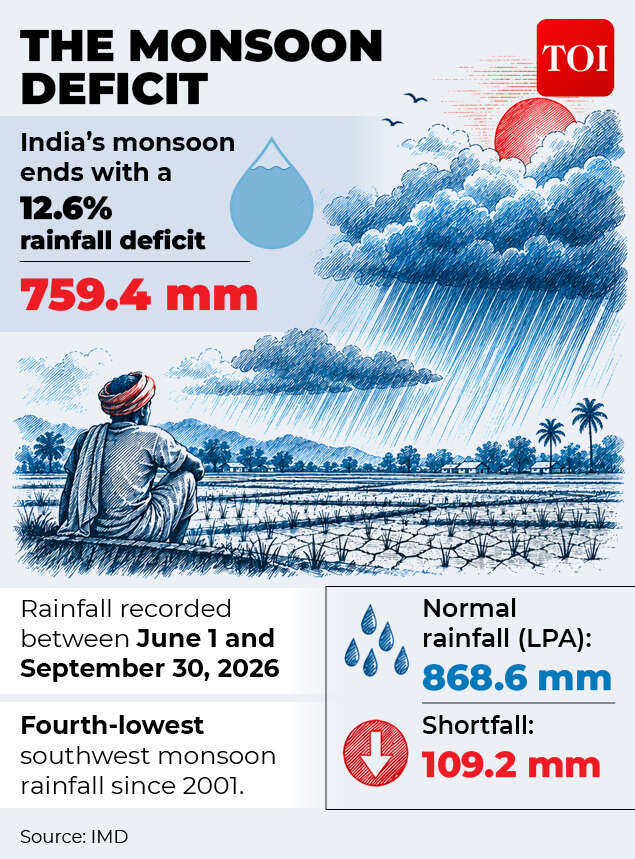
Data shows India’s rainfall deficit in 2026
Put simply, India’s rain gauge fell well short of its historical mark, and the deficit matters because the consequences of a weak monsoon can linger long after the season has withdrawn, affecting water availability, agriculture and the months ahead.El Niño was one of the major climate factors in focus during the season. In its first-stage forecast on April 13, the IMD projected rainfall at 92 per cent of the long-period average; its second-stage forecast revised this to 90 per cent. The eventual national total was lower still.The Ministry of Earth Sciences said these forecasts provided advance guidance for preparedness, while noting that the Indian Ocean Dipole and other atmospheric processes also affect monsoon performance.That distinction matters: El Niño can raise the risk of a weaker Indian monsoon, but it does not dictate the outcome on its own. In a December 2024 reply to Parliament, the Ministry of Earth Sciences noted that, among 16 El Niño years since 1950, seven had coincided with below-normal Indian monsoon rainfall. The inverse relationship is stronger in the later part of the season, particularly September.
Water, crops and the rabi season
The first consequences may be felt in places where rainfall deficits have already strained water supplies. A weak monsoon can mean less replenishment for reservoirs, rivers, ponds and groundwater, although local conditions vary considerably.What matters now is not just the national rainfall total, but where rain fell, how much water was captured and whether it remains available when farmers and households need it.The implications extend to the rabi season, when wheat, mustard, chickpeas and other winter crops are grown. In rain-fed areas, soil moisture and winter precipitation can be especially important. Where irrigation supplies are limited, farmers may face difficult decisions about sowing, crop choice and water use. Warmer conditions can also increase crop-water requirements.
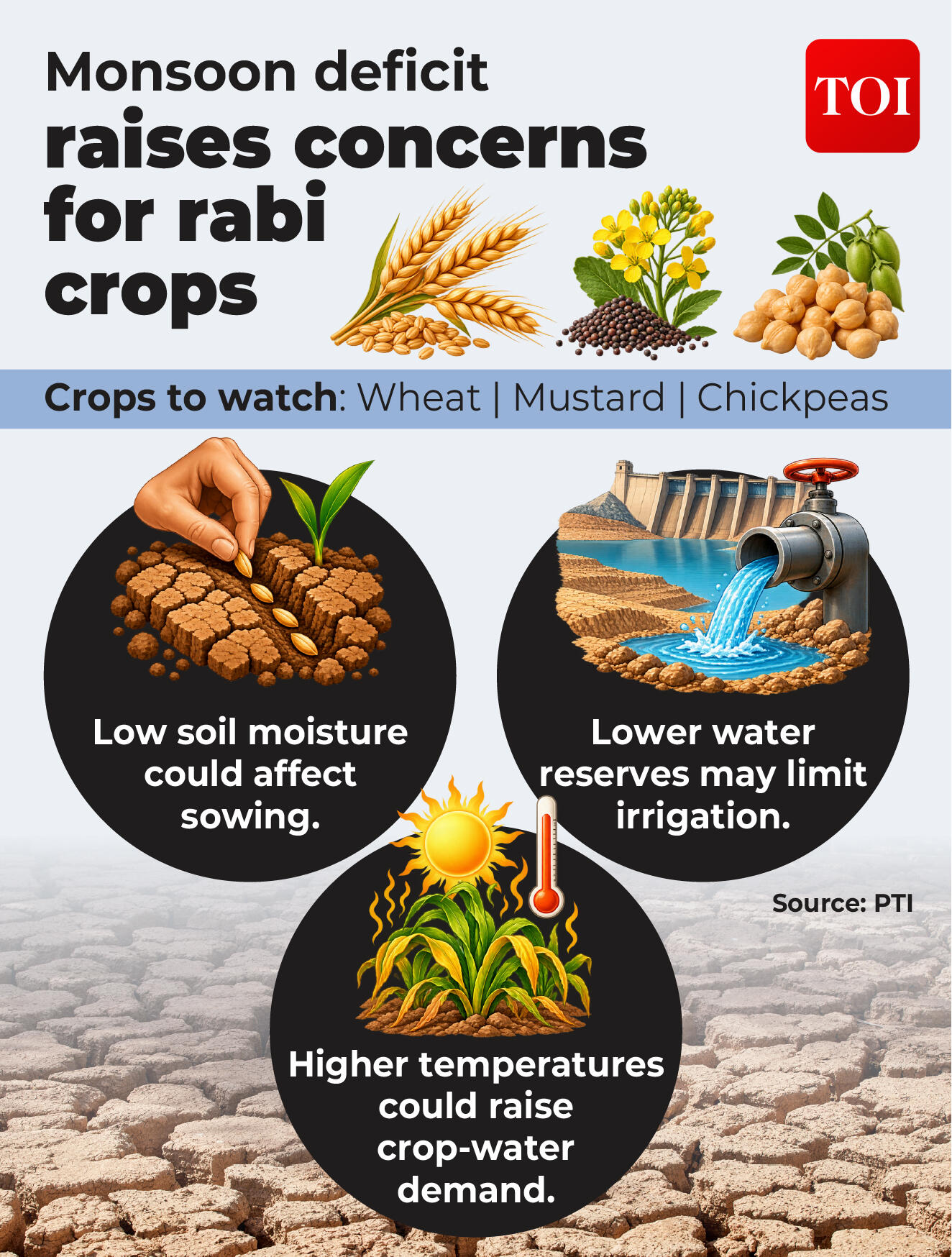
How does monsoon deficit raise concerns for crops
The risk should not be mistaken for a confirmed production loss. Actual outcomes will depend on local water availability, irrigation, crop choices, temperatures and subsequent rainfall. The IMD’s district-level forecasts and agricultural advisories will therefore be essential in translating a broad climate warning into practical decisions.Nor is the northeast monsoon irrelevant. As the southwest monsoon withdraws, the IMD has forecast conditions favourable for the onset of northeast monsoon rainfall over the southern peninsula, with a wet spell expected across parts of the region.Heavy rain was forecast for areas including Tamil Nadu, Puducherry, Kerala and parts of Karnataka and Andhra Pradesh during October 15–18. This rainfall is particularly important for Tamil Nadu and other parts of southeastern India.
A hotter 2027? The growing health concern
While the immediate focus is on winter, another concern is whether the effects of a powerful El Niño could extend into 2027, adding to the risk of extreme heat.One of the most alarming estimates comes from the University of Chicago’s Climate Impact Lab, whose researchers projected that the developing El Niño could contribute to approximately 4,51,000 additional heat-related deaths globally over the period covered by their analysis. According to news agency Reuters, their estimate for India was around 15,800 additional deaths over six months, compared with a normal year.
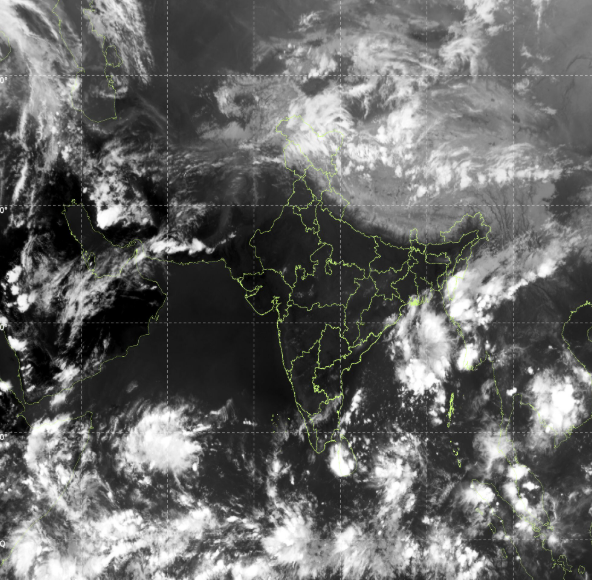
How Super El Nino is expected to impact India’s winters
A co-author told PTI that the analysis used the European Centre for Medium-Range Weather Forecasts’ SEAS5 seasonal forecast and a 1996–2025 baseline. Public-health experts have described the estimate as a warning for preparedness, while cautioning that the mortality projections themselves should be treated carefully.The underlying concern is serious: extreme heat can cause dehydration, heat exhaustion, heatstroke and worsen existing health problems. Outdoor workers, older people, children, pregnant women and people with chronic illnesses can face particular risks.A September 2026 commentary in The Lancet by Ruby Lieber, Dann Mitchell and Andy Haines called for stronger early-warning systems, health-system preparedness and research to identify the specific health impacts of El Niño.
Electricity: More demand, less supply
Heat also creates a challenge for India’s power system. Higher temperatures mean greater demand for air conditioning and cooling, while weaker winds and reduced rainfall can affect wind and hydropower generation.A July analysis by the Centre for Research on Energy and Clean Air (CREA) estimated that additional cooling demand could reach 10 terawatt-hours (TWh) over a year. Combining increased demand with reduced generation from some renewable sources, the report modelled a potential generation gap of nearly 18 TWh.In its central scenario, meeting the gap with additional coal-fired generation could release an estimated 17 million tonnes of carbon dioxide.This is the climate dilemma in practical terms: hotter conditions can raise electricity demand precisely when some sources of supply face weather-related constraints.
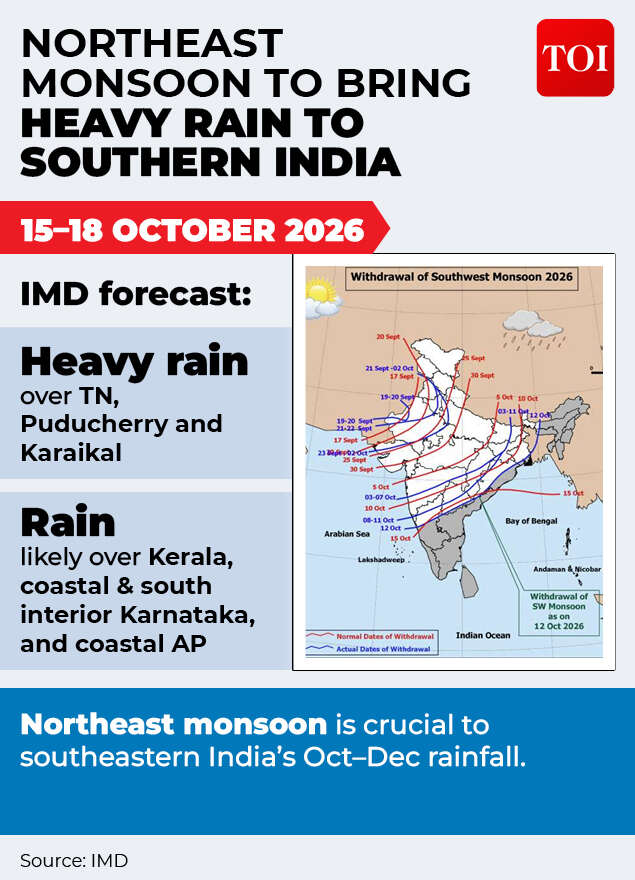
Heavy rainfall expected in parts of India
Climate change makes the baseline hotter
El Niño is a natural climate phenomenon; it is not caused by human-made climate change. But it operates on a planet already warmed by greenhouse-gas emissions.That higher baseline can intensify the consequences of a natural climate event, increasing the potential for dangerous heat and compounding risks from droughts, floods and crop stress.El Niño’s effects also vary by region. It can bring heavy rain to some areas and drought to others, which is why a global forecast cannot be translated into a uniform prediction for every Indian state.A positive Indian Ocean Dipole can also influence the Indian monsoon and may modify some of El Niño’s effects. The WMO’s October outlook forecast the positive Indian Ocean Dipole to peak in October before weakening.For India, the coming months will be a test of how these different weather systems interact. The monsoon deficit is already a reality, but the severity of El Niño and its effects on winter, agriculture and the summer of 2027 are still uncertain.The challenge now is to prepare for those possibilities without treating the forecasts as inevitable outcomes.